MANTRAYA ANALYSIS #95: 10 FEBRUARY 2026
BIBHU PRASAD ROUTRAY
Abstract
Democracy in Myanmar was effectively laid to rest in February 2021. The recent elections for the lower and upper houses of parliament have sealed its fate, burying any hopes for a revival—even under the most miraculous circumstances. This analysis examines the positions of three major international actors, together with the regional ASEAN organisation, regarding post-election Myanmar and their potential impact on the revival of democracy in the country.
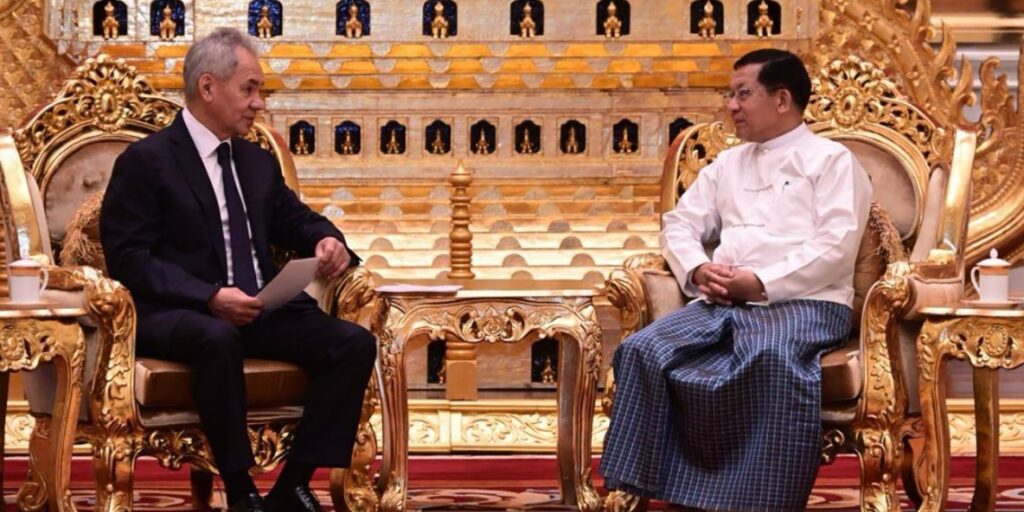
(Russian Security Council Secretary Sergei Shoigu with Myanmar’s Acting President
Min Aung Hlaing, in Naypyitaw, on 3 February 2026.)
Sham Elections and Outcomes
The three-phase elections held by the military junta in Myanmar concluded on 25 January, but the results were largely predictable even before the process began. Voting was blocked in many areas controlled by the opposition and ethnic armed organisations (EAOs). Voter turnout was low in the limited areas where the elections did take place, and the United Nations (UN) labelled the process a sham. During the polling, the military continued to attack opposition-held regions, resulting in the deaths of at least 170 people, a figure the UN has confirmed.
The military-backed Union Solidarity and Development Party (USDP) won 232 of the 263 seats in the lower Pyithu Hluttaw and 109 of the 157 seats in the upper Amyotha Hluttaw, according to results released on 29 and 30 January 2026. The remaining seats were divided among smaller parties whose views align closely with the junta or who are too pliable to act as genuine opposition.
The parliament is scheduled to convene in March, with the new government set to assume its duties in April. An article in Irrawaddy noted that the new parliament members are predominantly retired generals, including “ultranationalists, hate-speech promoters, pro-junta militia patrons, military officers who oversaw violent crackdowns on anti-coup protesters, and several individuals implicated in junta war crimes.”
The Rebuke
On 3 February, the U.S. President Donald Trump extended the declaration of a “national emergency” in Myanmar for another year, a step that allows American continuation of sanctions, which include a ban on the sale of jet fuel and blacklisting of banks that do business with the junta. The reason cited by Trump was ‘unusual and extraordinary threat to the national security and foreign policy of the United States’. The declaration had been promulgated in 2021, days after the coup that dislodged the democratically elected National League for Democracy (NLD) government. Trump also promised, in his usual style, that the U.S. would continue to monitor progress toward dialogue and reduction of violence in Myanmar. He promised to ‘calibrate pressure as necessary to protect American interests in and in relation to Burma’.
The declaration’s extension holds out a promise, but little else. It underlines that the US will not normalise its relationship with the new government in Myanmar. Trump, on 31 January, under the Burma Act to support democracy and human rights, had signed a government spending bill that includes $121 million in humanitarian aid for Myanmar, with the explicit rider that none of it can be delivered to the military regime. In the past, such funds have been used for cross-border assistance through Thailand and India, for a whole range of aid activities that are non-lethal in character and are mostly in support of local governance and federalism. Under the act, the participants in nonviolent civil disobedience can receive assistance for activities that include the collection of evidence of atrocities, justice and accountability for crimes committed against the Rohingya, and support for political prisoners. Though important issues, these are tactical matters in the strategic need for restoring democracy in Myanmar. Unless aided militarily by external powers, the opposition has little chance of ever posing a serious threat to the military.
The Trump-II administration has shown little concern for irregular conflicts in faraway territories unless its odd strategic logic conjures up a purported threat to American interests. The Myanmar military poses no such direct threat, apart from being a Chinese and Russian ally, as well as a possible source of refugees unlikely to make it to American soil. Myanmar is also a theatre for narcotics, online scam operations, and rare earth materials, all of which elsewhere have provided reasons for some amount of American adventurism. However, for the time being, none of these seems adequate to spur the US to turn aside from its rather meagre indirect humanitarian assistance-centred policy, much less to resort to active military pressure. Trump has instructed the State Department not to comment on foreign elections, which explains why the United States did not join the chorus of condemnation of the sham polls.
The Embrace
In contrast to the detached American position, Myanmar is China’s backyard, literally as well as strategically. Myanmar’s military owes its grab of power to Beijing and also to Moscow. China’s pro-stability (hence pro-status quoist) policy, especially after a 3-year hiatus between 2021 and 2024, has ensured that the armed movement by the EAOs and the People’s Defence Force (PDF) groups only limps along, albeit they seemed close to a breakthrough at one point. In 2024, China decided to directly intervene to ensure that a faltering Myanmar military remained in power, safeguarding its humongous range of economic and strategic interests.
Consider the case of Mandalay, the city that hosts the military’s Central Region Military Command. There, the pro-democracy armed groups, which included the Myanmar National Democratic Alliance Army (MNDAA) and Ta’ang National Liberation Army (TNLA), advanced as far as Patheingyi Township, just 22 kilometres short of Mandalay. And then, a Myanmar military counter-offensive involving Chinese-supplied military aircraft, drones, and artillery forced a retreat. Simultaneously, to bring the offensives to a halt, the Chinese leveraged the reality that the EAOs are dependent on the porous smuggling routes from China for basic needs like food and medicine. Beijing not only closed them down, but it also took steps to prevent weapons and munitions from reaching these groups.
The Shan State’s United Wa State Army (UWSA), the largest EAO in Myanmar, was asked by China to stop supplying weapons to the MNDAA and TNLA, and it had to oblige. In 2024, MNDAA’s chief, Peng Daren, was detained by China, and the group was forced to hand back to the military control over the strategic township of Lashio. There is thus considerable black humour in the Chinese framing of its electoral support for the military as backing for “the choice of the people of Myanmar” and “a development path that suits its national conditions.” An article in Irrawaddy aptly summed up, “Beijing may prove to be the biggest obstacle to a resistance resurgence”.
Such Chinese policies are to an extent mirrored by those of Russia, albeit Moscow has no direct land links with Myanmar. A symbiotic relationship between Moscow and Naypyitaw has strengthened over the years, and the Russians see ample scope for further cooperation with a military dictatorship they expect to remain the most powerful actor in the country.
Russian Security Council Secretary Sergei Shoigu, accompanied by Vasilii Osmakov, Russia’s deputy defence minister, landed in Naypyitaw on 2 February, after a six-hour flight from Beijing. This was the first visit by high-level Russian officials after Myanmar’s elections. Shoigu is no stranger to Myanmar, having visited the country several times in his previous role as Russian defence minister, 2012-2024. He was in China for “strategic communication as designated by President Vladimir Putin” with Chinese Foreign Minister Wang Yi. There, he expressed Russia’s support for China’s position on Taiwan. Myanmar didn’t figure in the visit press release by the Chinese foreign ministry, but both countries have been coordinating and complementing their activities in Myanmar.
In Naypyitaw, on 2 February, Osmakov’s official engagement included signing a five-year security pact with Deputy Defence Minister Maj Gen Aung Myo Thant. While details of the pact are yet to be released, past interactions between the two countries point to possible “emphasis on industrial integration, procurement of additional Russian military hardware, technology transfers, and maintenance of jet fighters, helicopters, and armoured vehicles for the Myanmar military.”
On 3 February, Shoigu met acting President Min Aung Hlaing to convey a congratulatory message from Putin on the recent poll. The message endorsed that the polls have indeed “taken place in accordance with international law.” Talks with National Security Advisor Tin Aung San Shoigu highlighted ongoing international pressure on both Russia and Myanmar. Moscow’s support to help protect “Myanmar’s sovereignty.”
Endorsement by Moscow, a pariah under wide-ranging Western sanctions, may not mean much to the world but is of immense importance to the Myanmar military’s desperate search for legitimacy. In return, Russia too receives moral and some logistical support from Myanmar for its aggression in Ukraine. In fact, a report in 2023 had indicated that 120mm mortar rounds produced in Myanmar were being used by Russian forces in Ukraine. Strategically, Myanmar has served as a strategic anchor to Russia in Southeast Asia, providing Moscow with a diplomatic ally and a friendly port.
Undecided as well as Incapacitated
Between the positions of the US, China, and Russia are the timid actions taken by Myanmar’s neighbours in Southeast Asia and South Asia, most notably India. The Association of Southeast Asian Nations (ASEAN), of which Myanmar is a suspended member, has refused to endorse the election results, with an ‘as of now’ caveat, thereby keeping the window open for later engagement with the stubborn military. The organisation had refused to send in a team of observers to monitor the polls. This does not matter much, since the ASEAN position – feebly insisting that the democratic forces be allowed to play a free role in the country’s politics – has been a nonstarter. One reason for division within ASEAN, of course, is that the nearby states that traditionally have played the largest role (Thailand, Laos, and Cambodia) are now neutralised by both self-dealing and Chinese pressure. It is unlikely that the group, which operates on “consultation and consensus,” can reach any common position to influence the Myanmar military.
India is likewise disinterested in moving beyond tacit support for the junta. During the three-phase polls, a former General Officer Commanding-in-Chief of the Indian Army’s South Western Command led a delegation of election observers to join similar teams from Russia and China. India’s Ministry of External Affairs (MEA), which called for ‘inclusive and fair’ elections, later termed the delegation as private individuals who did not represent the government. In a dissimilar fashion, New Delhi has not shied away from engaging with the military since the coup. India apparently feels compelled to meet China’s overarching role in Myanmar and hence follows a policy that does no service to the promotion of democracy in that country.
Whither Democracy
It should thus not surprise that the future of democracy in Myanmar is uncertain. The recent polls have solidified the military’s control over power and have been selectively endorsed by key international players whose strategic interests supersede democratic ideals. Shifts in regional politics could play a positive role, as could a breakdown in regime unity or a growth of popular will to resist. As matters stand now, however, there is no immediate prospect that democracy will emerge from the shadows cast by international indifference and authoritarian rule.
(Dr. Bibhu Prasad Routray is the Director of MISS. This analysis has been published as part of the ongoing “Fragility, Conflict, and Peace Building” project. All MISS publications are peer-reviewed.)