MANTRAYA, 7 AUGUST 2026
Abstract
In July 2026, the terrorism landscape in South Asia depicted important trends. Pakistan faced record monthly fatalities driven by an escalating, tactically sophisticated Baloch-TTP insurgency, alongside renewed violence in Jammu & Kashmir and growing evidence of Afghanistan consolidating as a regional terror hub.
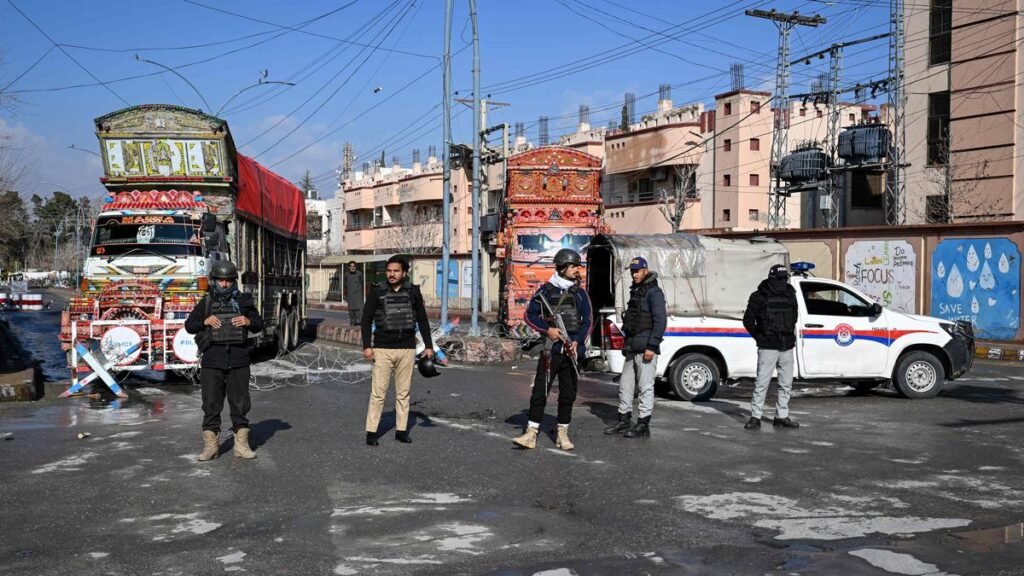
(Security personnel cordon off a road leading to the blast site in Quetta on 1 February 2026,
a day after an attack by Baloch separatists. Photo Credit: The Hindu)
South Asian Trends[1]
Terrorism. Related Fatalities in South Asia: July
| Civilians | Security Personnel | Terrorists/Insurgents | Total | |
| India | 02 | 04 | 01 | 07 |
| Pakistan | 118 | 206 | 363 | 687 |
Baloch insurgency dominates Pakistan’s terrorism landscape: In the first seven months of 2026, Pakistan has witnessed 2786 terrorism related fatalities, which includes 1857 militants, 434 security force personnel and 495 civilians (including 32 Peace Committee members). The month of July was characterised by highly coordinated attacks on security forces, state institutions and transport infrastructure, especially in Balochistan. In this month, Pakistan reported 616 terrorism related fatalities, including 103 civilians and Peace Committee members, 112 security force personnel, and 401 terrorists. This monthly figure is the highest in the first seven months of the year. 372 of these fatalities (over 60 percent) have been reported from Balochistan. Over 37 percent (233 fatalities) are from the Khyber Pakhtunkhwa province, dominated by the Tehreek-e-Taliban Pakistan (TTP) group.
Between 4 and 8 July, militants carried out synchronised assaults on police posts, military positions and security installations across multiple districts of Balochistan, killing 38 security personnel and four civilians. Pakistan attributed the attacks to cooperation between the Baloch Liberation Army (BLA) and the TTP. On the evening of 30 July, at least 13 security force personnel were killed in an attack by a large group of suspected Baloch insurgents on two army posts near Quetta, the provincial capital of Balochistan. The previous day, on 29 July, at least 10 security force personnel were killed in two separate attacks on military convoys in Kachhi district of Balochistan.
Both in KP and Balochistan, militants continue to prioritise attrition of security apparatus in addition to attacks on civilians. In Balochistan, civilians killed by the insurgents include the non-local labourers of Punjabi ethnicity.
Terrorism. Related Fatalities in Balochistan & KP: July
| Civilians* | Security Personnel | Terrorists/Insurgents | Total | |
| Balochistan | 72 | 62 | 238 | 372 |
| Khyber Pakhtunkhwa (KP) (Mainland as well as merged districts/FATA) | 21 | 49 | 163 | 233 |
*Includes Peace Committee members.
Increasing tactical sophistication in militant attacks in Pakistan: The attacks in July displayed several trends pointing to the increasing use of coordinated multi-site attacks, suicide tactics, drones/quadcopters for reconnaissance or attacks, and simultaneous assaults on multiple security positions. Three attacks involving drones took place in KP’s Bannu district in July, although the police officials have assessed that the militants are “still trying to master the use of the drones”, and “that’s why they can’t hit their targets accurately”. There were eight suicide attacks carried out by terrorists, including five involving Vehicle-Borne IEDs (VBIEDs).
In attacks that took place between 4-8 July, multiple militant teams operated simultaneously over a wide geographical area. As a result, security forces had to respond to numerous incidents simultaneously, stretching available resources. Moreover, the militants seem to be frequently orchestrating the ‘bait-and-ambush attacks’, which involve one attack on a security force installation and another on the responding force. The insurgency is clearly evolving beyond isolated attacks toward more complex operations.
Terrorism. Related Fatalities in India: July
| Civilians | Security Personnel | Terrorists/Insurgents | Total | |
| Jammu & Kashmir | 02 | 01 | 01 | 04 |
| Manipur | 00 | 02 | 00 | 02 |
| Nagaland | 00 | 01 | 00 | 01 |
Jammu & Kashmir witnesses terrorism related killings: On 22 July, terrorists shot and killed a police head constable manning a busy street on the Anantnag-Kokernag road near the Lal Chowk area of Anantnag district, prompting one of the largest security crackdowns in recent years. In the CCTV footage, the militant was seen fleeing with his rifle after fatally shooting the police personnel from close range as he emerged from a shop.
Authorities detained over 1200 suspects during follow-up operations, including 700 in the capital, Srinagar. On 23 July, security forces blasted and demolished two residential houses of local terrorists in south Kashmir. The police establishment has repeatedly used this tactic to deter locals from joining terror groups. Security agencies continued search operations to dismantle local support networks and identify overground workers linked to terrorist organisations.
In the second incident of the month, on 31 July, two migrant labourers from Chhattisgarh were killed after terrorists opened fire on them at a brick kiln in Kellam village of Kulgam district. One died at the scene, and the second succumbed to his injuries during treatment. These two incidents of killing pointed to the possible trend of terrorists continuing to rely on small, targeted attacks against individual security personnel and non-locals rather than large-scale attacks. The apparent objective is to create a persistent security challenge while avoiding major confrontations that could lead to a loss of their dwindling pool of operatives. The most recent publicly reported estimate (mid-2026) from Indian security sources places the number of active militants at around 70–80 in Jammu and Kashmir. Of them, 45 to 50 are believed to be of Pakistani origin, and 25 to 30 are local militants.
India’s focus on cross-border terrorism: Although levels of militant infiltration from across the border with Pakistan remain relatively controlled, Pakistan-based terrorist infrastructure continued to dominate India’s threat assessment. The issue remained central to India’s diplomatic engagement throughout July. On 22 July, India reiterated at the United Nations that Pakistan continues to employ cross-border terrorism as an instrument of state policy. “The only outstanding issue about Jammu and Kashmir is the naked aggression and illegal occupation of India’s sovereign territory by Pakistan. Instead of pointing fingers at India, Pakistan would serve itself and its people far better by putting its own house in order”, India’s Permanent Representative to the United Nations, Ambassador Parvathaneni Harish said. Separately, at the ASEAN Regional Forum in Manila, on 23 July, India’s External Affairs Minister S. Jaishankar called for stronger international cooperation to choke terror financing and disrupt terrorist support networks. Diplomatic pressure against state-sponsored terrorism remains an important component of India’s counter-terrorism strategy.
Afghanistan could be remerging as a terror hub: On 28 July, Zabihullah Amiri, the Taliban’s director of information and culture in Badakhshan, was killed by two armed motorcyclists on the Fayzabad-Baharak road. The regional affiliate Islamic State Khorasan Province (ISKP) claimed responsibility for the targeted assassination. While the Taliban continue to enforce absolute control over Afghanistan through its strict interpretation of Sharia law, much of its counter-terrorism focus is mostly directed at the ISKP, and it pays little attention to preventing other groups from operating in the country.
This may have allowed global terrorist groups, including al-Qaeda, to turn Afghanistan into a base for recruiting, training and deploying militants beyond the country’s borders. Taliban control over Afghanistan also transformed the entire country into an information black hole, with very little knowledge on the operations by these transnational jihadist groups. Nevertheless, statements of representatives of nations that run their embassies in that country continue to indicate that groups like the AQ, ISKP, and several Central Asian jihadist organisations continue to operate in the country.
On 15 July, Russia’s foreign minister Sergey Lavrov said that ISKP is attempting to use Afghanistan as a base to expand its activities and establish a caliphate. Further, Alexander Zuev, the acting UN Under-Secretary-General for Counter-Terrorism, in an interview with Russia’s TASS news agency (published on 17 July), also claimed that AQ still maintains a presence in Afghanistan, although its activities in the country have significantly declined. He maintained that the ISKP and TTP are currently the most active militant groups operating in Afghanistan. Responding to those remarks, the spokesperson for Afghanistan’s Ministry of Interior said: “The Islamic Emirate remains committed to its obligations under the Doha Agreement and does not allow any group to operate from Afghan territory”. Notwithstanding such assertion, a shift has already taken place from domestic terrorism in Afghanistan to the country’s potential role as a regional hub for terrorist activity in the near to medium term.
Projections for August 2026:
On the basis of the outlined trends, SATTP makes the following projections for South Asia for August 2026.
Pakistan: Expect continued high fatalities in August, with Balochistan remaining the epicentre. The BLA-TTP coordinated, multi-site “bait-and-ambush” attacks on security convoys/posts will likely persist, particularly around Quetta, Kachhi, and KP’s Bannu. Security-force and militant casualties will likely stay comparable to July’s levels given the trajectory since May-June.
India: Jammu & Kashmir may likely see a continuation of isolated targeted killings of individual security personnel and non-local labourers. Expect intensified cordon-and-search operations and continued Indian diplomatic emphasis on cross-border terrorism at international forums.
Afghanistan: Afghanistan will likely continue consolidating as a regional militant haven through August, with ISKP, AQ, and TTP maintaining or expanding operational presence despite Taliban denials, and Taliban counter-terror efforts remaining narrowly focused on ISKP while tolerating other groups. The ISKP may try to replicate another attack on a Taliban high official.
In Pakistan and Afghanistan, insurgent capability is outpacing state response in key theatres. Unless regional counter-terrorism cooperation and internal governance measures improve, the region risks entering a more sustained and interconnected cycle of violence through the rest of 2026.
End Note
[1] Data for India used in this trend analysis are from South Asia Terrorism Portal (https://satp.org/). Data for Pakistan are from Pakistan Institute for Conflict and Security Studies (https://www.picss.net/).
(South Asia Terrorism Trends and Projections (SATTP) is a new monthly briefing by MISS, which tracks extremism, radicalisation, terrorism-related violence and militant activity across South Asia. Each edition combines a data-driven fatality breakdown with analysis of the month’s key incidents, emerging tactical patterns, and shifting militant dynamics, with long-view projections for the month ahead. Based on incident reporting, official statements, regional and local security sources, SATTP aims to provide readers with a clear, concise picture and prognosis of the region’s terrorism landscape and future trends. SATTP is published as part of Mantraya’s ongoing “Mapping Terror & Insurgent Networks” and “Fragility, Conflict, and Peace Building” projects.)