MANTRAYA, 4 SEPTEMBER 2026
Abstract
In August 2026, terrorism trends across South Asia highlighted intense militant violence and a shift toward weaponised drones in Pakistan, decentralised terror networks in India, and a rise in anti-Taliban armed opposition activities in Afghanistan. Projections anticipate continued violence across all three theatres into September 2026.
South Asian Trends[1]
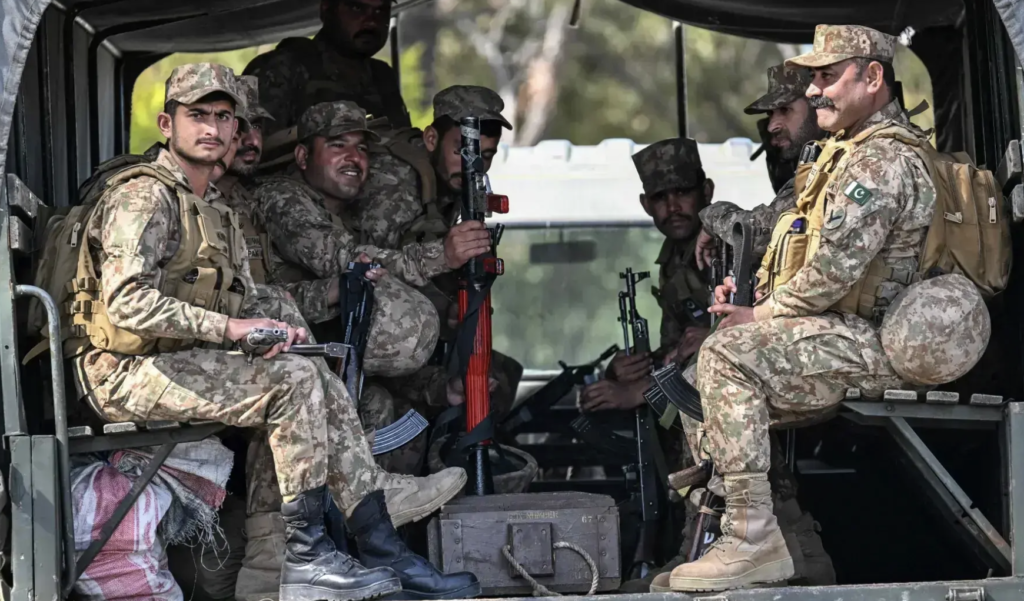
(Pakistani army soldiers arrive for deployment at the Red Zone area of Islamabad on 10 April 2026, Photo Courtesy: Dawn)
Terrorism. Related Fatalities in South Asia: August
| Civilians | Security Personnel | Terrorists/Insurgents | Total | |
| India | 10 | 00 | 02 | 12 |
| Pakistan | 81 | 70 | 375 | 526 |
(i) Intense terrorism-related violence in Pakistan: July was the worst terrorism affected month of the year, in which deaths among civilians and security forces outpaced those of the militants. August restored the graph somewhat in the state’s favour. Compared to 688 fatalities in July, August registered fewer, yet significantly higher deaths. A total of 526 people, including 375 terrorists, died. Balochistan and Khyber Pakhtunkhwa (KP) account for 99 percent of the terrorism related fatalities in the country. According to the data compiled by Pakistan Institute for Conflict and Peace Studies (PICSS), tactical assaults emerged as the most frequently used tactic by the militant groups, with 47 such incidents recorded in August. In addition, there were 46 target killings and 36 attacks where IEDs were used. Three suicide attacks, including two incidents involving VBIEDs, were reported in the month. Pakistan is ranked first on the 2026 Global Terrorism Index amid attacks primarily driven by the Tehrik-e-Taliban Pakistan (TTP) and the Balochistan Liberation Army (BLA), groups Islamabad accuses Afghanistan and India of sponsoring, allegations both countries deny.
Terrorism. Related Fatalities in Balochistan & KP: August
| Civilians | Security Personnel | Terrorists/Insurgents | Total | |
| Balochistan | 45 | 44 | 195 | 284 |
| Khyber Pakhtunkhwa (KP) | 33 | 24 | 180 | 237 |
(ii) Balochistan emerges as the worst violence-affected province: With 237 fatalities, albeit more than 66 percent of which were militants, Balochistan was the worst terrorism affected province in August. The militants relied on a combination of IED warfare, ambushes, mobility disruption and economic coercion tactics. Their objective appears to be broader than simply inflicting casualties on the security forces and the Punjabi-speaking non-local population. PICSS data records a total of 89 terrorist attacks in August. Between 9 and 15 August, the BLA claimed 22 attacks, claiming that 26 Pakistani military and government-backed personnel were killed. Their chosen targets included security forces, police, security installations, infrastructure and commercial vehicles. On 22 August, in the BLA attack in Khadkocha, Mastung, an IED was used against a security-force convoy, killing 13 security personnel. Not surprisingly, the province has remained the focus of the counter-terrorism operations, which have resulted in the deaths of 195 militants and 44 security force personnel. A total of 891 militants have already been killed in the province till 31 August. At the same time, 985 security forces and 361 civilians have been killed.
(ii) Rapidly escalating tactical shift by the TTP in Pakistan: The TTP continued to be the most prominent militant threat in KP. PICSS recorded 59 terrorist attacks in mainland KP and another 52 attacks in the merged districts (FATA) in August. The most significant incident was the 2 August suicide bombing near Kabal Police Station in Swat, in which at least 17 people, including seven policemen and civilians, were killed. The attack occurred while a pro-police/anti-terrorism gathering was taking place nearby and was claimed by the TTP. In other incidents, on 17 August, two TTP militants, including a suicide bomber, attempted to attack a security-forces vehicle using an explosive-laden rickshaw in Bannu. On 19 August, militants used drones to attack a security position in South Waziristan.
Quite visibly, the TTP tactic is transitioning from its traditional tactic of ground ambushes to weaponised, commercial-grade quadcopters modified to drop mortar shells and IEDs, which demonstrates that the Pakistan state’s efforts to militarily confront them within Pakistan and in Afghanistan have not succeeded. According to a news report, 320 quadcopter attacks took place in Bannu district in 2025, followed by 34 in North and South Waziristan districts and 21 in Bajaur. Several such attacks have been executed this year as well. On 14 August, celebrated as Pakistan’s Independence Day, the TTP executed three coordinated quadcopter drone attacks targeting three law enforcement positions in the Banda Daud Shah tehsil of Karak district. Three Pakistani police officers sustained minor injuries when an explosive dropped from one of the quadcopters detonated during routine duties. The simultaneous use of multiple quadcopters against police positions is particularly significant because it suggests an effort to overcome fixed-site security and surveillance. In response, the local police utilised newly deployed anti-drone guns and drone locators to intercept and jam some quadcopters across four locations, preventing more severe casualties.
Terrorism. Related Fatalities in India: August
| Civilians | Security Personnel | Terrorists/Insurgents | Total | |
| Jammu & Kashmir | 00 | 00 | 00 | 00 |
| Manipur | 10 | 00 | 02 | 12 |
| Left-wing Extremism | 00 | 00 | 00 | 00 |
(iv) Manipur remains an unsolved tinderbox: All of India’s 12 terrorism related fatalities in August were reported from Manipur. Among them were 10 civilians, all of whom were killed in the district of Kangpokpi in the cyclical violence between the Naga and the Kuki tribals. On 14 August, two Naga civilians were killed and two others injured after suspected Kuki National Front-Presidential faction (KNF-P) cadres opened fire on farmers in their fields at Langka Naga village. Five Naga civilians travelling in a vehicle along the Imphal-Tamenglong (IT) road in Kangpokpi district were killed on 27 August in an ambush by suspected militants of the Kuki National Front-Presidential (KNF-P) and Kuki Revolutionary Army (KRA). Four days later, in what appeared to be a retributive attack, three Kuki civilians, including two women, were killed and four others injured when suspected cadres of National Socialist Council of Nagalim-Isak-Muivah (NSCN-IM) and Zeliangrong United Front-Kamson (ZUF-K) attacked a Kuki village in the same district. Early in the morning, the attackers opened fire on residents and set several houses ablaze. Further, two Naga insurgents—one each belonging to the ZUF-K and ZUF-J—were killed in internecine warfare in Noney district on 28 and 29 August.
(v) India’s terrorism challenge is transforming into a more modular and decentralised form: Compared to Pakistan, India’s terrorism related fatalities are minimal. However, the country’s security establishment continues to focus on disrupting the dispersed domestic terror cells that they claim operate in tandem with the cross-border organised terror networks. The most important development of the month was the nationwide crackdown on the alleged Shahzad Bhatti Network, backed by Pakistan’s Inter-Services Intelligence (ISI) on 12 August. Bhatti is a known Pakistani gangster and social media influencer, believed to be based in the UAE. Indian government sources claim that in the past year, he has graduated from organised crime to terror-related activities, at the behest of the ISI. His earliest association with criminal activities in India started in Punjab and has since spread across 14 States.
Ahead of India’s Independence Day celebrations, security agencies detained 253 people across 14 states. Authorities said the network was linked to grenade, IED and petrol-bomb attacks, targeted killings, reconnaissance of police, defence and religious sites, and the installation of CCTV cameras for espionage. Recoveries reportedly included IEDs, grenades bearing Pakistan Ordnance Factory markings, pistols, ammunition and surveillance equipment. The Indian security establishment claims that the terrorist mobilisation in the country is becoming more modular and decentralised.
(vi) Low-intensity anti-Taliban resistance grows in Afghanistan: Afghanistan’s security environment is becoming increasingly fragmented with the steady consolidation of anti-Taliban resistance movements. August 2026 witnessed geographically dispersed but largely low-intensity anti-Taliban armed attacks by the National Resistance Front (NRF), Afghanistan Freedom Front (AFF) and United Front of Afghanistan (UFA), who claimed attacks across northern, western and southern provinces, including Herat, Badakhshan, Kunduz, Baghlan, Faryab, Nuristan and Kandahar.
These groups have increasingly targeted Taliban intelligence personnel, police, patrols, local administrators and military installations in efforts to weaken the regime’s administrative and coercive apparatus. The NRF claimed to have killed Abdul Rahman Mansour, the Taliban mayor of Faizabad and his guards on 13 August.
Badakhshan’s Zebak, Nusay, Yaftal and Faizabad districts witnessed sporadic attacks by the NRF, AFF, and Sepahiyan-e Mihan Front (SMF) on the Taliban positions and personnel. The SMF briefly seized the district centre of Yaftal before being dislodged by the Taliban troops. The other districts which witnessed such violence included Kabul by the AFF, Takhar by the Afghanistan Green Trend, Baghlan by the NRF and newly formed Afghan United Front (AUF), Kunduz, Kandahar and Faryab by the AUF.
So far, the Taliban has been denying either the existence of these groups or their disruptive potential, while quietly launching targeted military operations and night raids to arrest or kill suspected members. August, however, demonstrated signs of the growing unease among the Taliban with the increase in such attacks. On 4 August, Abdul Hakim Mohammad Nezami, deputy commander of the Taliban’s 201 Khalid bin Walid Army Corps, said Taliban members were again prepared to conduct suicide operations in response to increased activity by armed opposition groups. On 13 August, Taliban spokesman Zabihullah Mujahid said opposition groups are divided and pursue different goals, rejecting a political settlement with them and warned that their return to power could take Afghanistan back to past conditions. On 15 August, Taliban chief Mullah Hibatullah Akhunzada, on the occasion of the fifth anniversary of the Taliban’s return to power, said that his opponents should abandon their armed resistance, return to Afghanistan, and accept Taliban rule, signalling thereby that the regime has no intention of making concessions or forming an inclusive government.
Projections for September 2026:
On the basis of the outlined trends, SATTP makes the following projections for South Asia for September 2026.
Pakistan: Terrorism-related violence is likely to remain high in Balochistan and KP, with the BLA and TTP continuing to sustain pressure on security forces. Balochistan is likely to remain the principal theatre, while militant attacks may continue to combine IEDs, ambushes, target killings and attacks on infrastructure. The TTP, on the other hand, is likely to expand its use of commercial-grade weaponised quadcopters against police and security positions in KP, particularly where fixed-site security creates exploitable vulnerabilities. Pakistani security forces are likely to continue responding with counter-terrorism operations.
The BLA is likely to maintain a multi-dimensional campaign combining attacks on security forces with disruption of transport, infrastructure and commercial activity in Balochistan. Further attacks on security convoys and installations, including through IEDs and ambushes, are highly probable.
India: Terrorism-related fatalities are likely to remain relatively low, but the security challenge will increasingly involve small, decentralised cells and hybrid crime-terror networks. Security agencies are likely to intensify preventive arrests, surveillance and weapons seizures, particularly against networks suspected of links with Pakistan-based actors. Inter-community violence is likely to remain the principal source of terrorism-related casualties in India, with the possibility of retaliatory attacks between Naga- and Kuki-affiliated armed groups in Manipur. Ambushes, attacks on civilians and internecine clashes could continue, particularly in vulnerable areas of Kangpokpi and neighbouring districts.
Afghanistan: Anti-Taliban armed resistance is likely to persist at a low but geographically dispersed intensity. The NRF, AFF and other emerging groups are likely to continue targeting Taliban security and administrative personnel rather than attempting sustained territorial control. Taliban counter-operations and night raids are likely to intensify. The Taliban is unlikely to make meaningful concessions to the armed opposition. Instead, its response is likely to combine denial of the opposition’s strength, targeted counter-insurgency operations and increasingly assertive rhetoric, potentially reinforcing the cycle of low-intensity resistance.
End Note
[1] Data for India used in this trend analysis are from South Asia Terrorism Portal (https://satp.org/), unless specified otherwise.
(South Asia Terrorism Trends and Projections (SATTP) is a monthly briefing by MISS, which tracks extremism, radicalisation, terrorism-related violence and militant activity across South Asia. Each edition combines a data-driven fatality breakdown with analysis of the month’s key incidents, emerging tactical patterns, and shifting militant dynamics, with long-view projections for the month ahead. Based on incident reporting, official statements, regional and local security sources, SATTP aims to provide readers with a clear, concise picture and prognosis of the region’s terrorism landscape and future trends. SATTP is published as part of Mantraya’s ongoing “Mapping Terror & Insurgent Networks” and “Fragility, Conflict, and Peace Building” projects.)