
MANTRAYA, 6 NOVEMBER 2026
Abstract
In October 2026, a pattern and trend analysis of South Asia’s terrorism landscape depicted a threat concentrated in Pakistan and Afghanistan. Pakistan recorded 603 deaths, a marginal decline from 634 in September. Baloch insurgents expanded into the maritime domain and attacked infrastructure, while the TTP attacks continued to include drones in Khyber Pakhtunkhwa. Pakistan-Taliban tensions deepened, and anti-Taliban resistance expanded its footprint across Afghanistan. India’s terrorism landscape was dominated by Manipur, which witnessed 23 deaths.
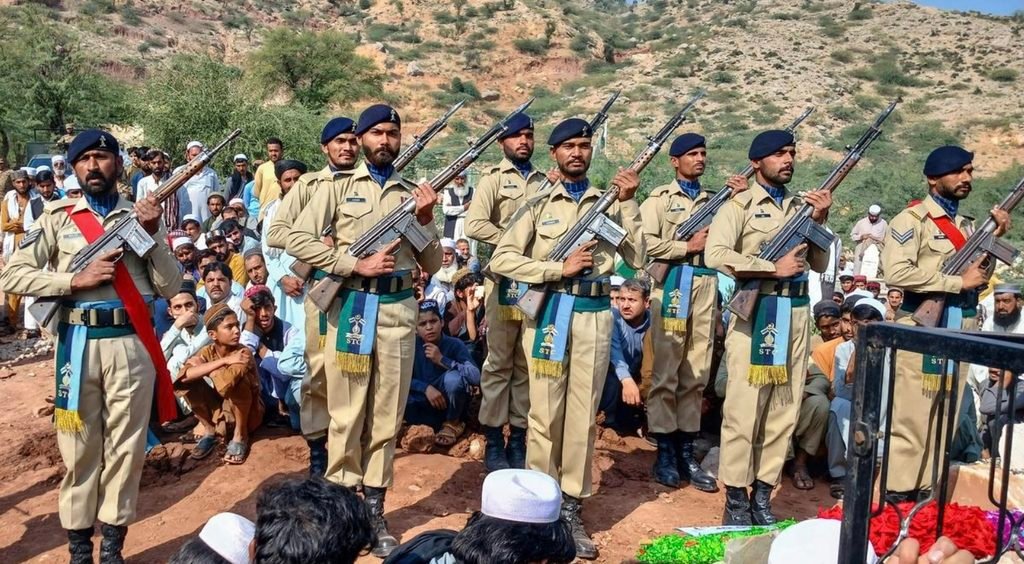
(Pakistan Army’s ceremonial guards perform during the funeral ceremony of a paramilitary personnel of the Frontier Corps
killed during the Afghanistan-Pakistan border clashes, in Kohat on 17 October 2025. Photo Credit: The Hindu)
South Asian Trends
Terrorism. Related Fatalities in South Asia: October
| Civilians | Security Personnel | Terrorists/Insurgents | Total | |
| India | 20 | 01 | 09 | 30 |
| Pakistan | 71 | 77 | 455 | 603 |
The month of October 2026 demonstrated that South Asia’s terrorism threat remains concentrated in Pakistan, with persistent but distinct security challenges in India’s Jammu and Kashmir and Manipur.
(i) Minimal reduction, but sustained militant violence in Pakistan: Although overall violence dipped marginally, terrorism remained a major source of Pakistan’s instability in the two provinces of Khyber Pakhtunkhwa (KP) and Balochistan. Compared to 634 fatalities in September, the month of October recorded 603 deaths. This included 71 civilians, 77 security force personnel and 455 militants.[1] Fatalities among security forces declined significantly compared to September, owing possibly to the aggressive intelligence-based operations and targeted strikes by the security forces, which have led to a decline in militant attacks. Compared to 226 militant attacks in September, October witnessed only 143 attacks.[2] Between 2 and 4 October, security forces reported multiple intelligence-based operations in North Waziristan, Dera Ismail Khan, Bajaur and South Waziristan, killing several suspected militants. On 4 October, security forces also reported killing at least 15 militants during an attempted infiltration across the Afghanistan–Pakistan border in North Waziristan. Further operations between 14 and 16 October resulted in at least 88 militant fatalities in Tank, North Waziristan, Bajaur, Swat and Khyber districts. Only one suicide attack was carried out by the militants in October, compared to three in September. On 17 October, a suicide attacker rammed an explosives-laden vehicle into the boundary wall of a security forces’ camp in Mir Ali area of North Waziristan district, triggering a powerful explosion. Three other militants who tried to storm the camp were gunned down by the security personnel before they could enter. In a similar incident in Bajaur district, security forces foiled a major terror attempt after destroying an explosives-laden vehicle through gunfire. No loss of life was reported in the incident.
Terrorism. Related Fatalities in Balochistan and KP: October
| Civilians | Security Personnel | Terrorists/Insurgents | Total | |
| Balochistan | 41 | 48 | 191 | 280 |
| Khyber Pakhtunkhwa (KP) | 30 | 29 | 263 | 322 |
(ii) Baloch insurgency goes maritime: Of the 143 terror attacks countrywide in October, 71 took place in Balochistan, according to PICSS. 41 civilians, 48 security force personnel and 191 insurgents were killed in the province, according to the South Asia Terrorism Portal. The biggest attack of the month by the Baloch insurgents took place on 11 October, in which 13 Pakistan Coast Guard (PCG) personnel were killed when the Baloch Liberation Army (BLA)’s maritime unit, the Hammal Maritime Defence Force (HMDF), attacked two PCG boats in the Jiwani area of Gwadar district. On the same day, 28 BLA cadres were killed by the PCG personnel. The creation of its maritime unit had been announced by the BLA in April 2026. Although Pakistan military sources play down the development, the expansion of the conflict into the maritime domain poses a new challenge for Pakistan. Apart from this, on 4 October, the Baloch Republican Guards (BRG) cadres reportedly destroyed two electricity transmission towers in Sibi district, while bomb attacks on 5 October damaged railway tracks at two locations in the same district. On 11 October, at least nine gas pipelines were damaged in multiple explosions at different locations in Sui revenue unit of Dera Bugti district. These incidents illustrate a pattern of attacks against transport links and electricity infrastructure. Such targeting can impose costs beyond immediate casualties by disrupting railway operations, undermining public confidence and complicating infrastructure development.
(iii) Use of technology in militant attacks on the rise in KP: With 70 terror attacks and 322 fatalities, KP emerged as the worst violence-affected province in October. 30 civilians, 29 security force personnel and 263 militants were killed. Despite the losses suffered, the militants intensified technology-driven and asymmetric attacks across the province, with a heavy reliance on weaponised commercial drones, quadcopters, and IED ambushes targeting police and military installations. On 4 October, three consecutive quadcopter attacks struck a populated area in Azam Warsak, South Waziristan, injuring two people; on 5 October, a drone attack on civilians in Mir Ali, North Waziristan, killed a child and injured seven others. On 9 October, militants targeted Raghzai Police Station in South Waziristan with a quadcopter, while on 16 October, a drone struck Tank City Police Station without causing casualties. On 25 October, a quadcopter attack on the Bagyari Joint Post of the Khyber Rifles in Khyber district injured a soldier, while police intercepted and neutralised a separate drone targeting a post in Suleman Khel, Badhaber, Peshawar. The following day, militants attempted to drop an IED onto Hassan Khel Police Station in Peshawar, but the explosive became entangled in the station’s anti-drone net. On 26 October, a drone-dropped explosive killed a resident in Bannu’s Sardi Khel area. These incidents point to a growing militant capability to use inexpensive commercial UAVs for surveillance, precision attacks and explosive delivery, challenging conventional security infrastructure and forcing police and military installations to invest in counter-drone measures.
(iv) Cross-border militancy deepens Pakistan-Taliban confrontation: The TTP threat continued to aggravate Pakistan’s confrontation with the Taliban authorities in Afghanistan, with increasingly overlapping militant infiltration, retaliatory military operations and border clashes. Pakistan’s airstrikes on 1 October in Kunar and Helmand, which Islamabad said targeted TTP and BLA hideouts, killed at least 10 civilians, mostly children, according to UNAMA, and injured nine others. The Taliban rejected Pakistan’s accusations of providing sanctuary to anti-Pakistan militants, while Islamabad continued to insist that Kabul must act against the TTP. On 4 October, Pakistani security forces reportedly killed at least 15 TTP militants, including commander Mazdigari Marwat, while repelling an infiltration attempt in the Ghulam Khan sector of North Waziristan. On 17 October, Pakistani forces and Afghan Taliban personnel exchanged fire for several hours in Kurram district and across the border in Paktia’s Dand Patan and Zazi Aryob districts, with Pakistani artillery reportedly striking Taliban positions and nearby residential areas. On 19 October, clashes continued for several hours in Paktika’s Barmal and Angoor Adda areas, near the Durand Line, involving heavy weapons and prompting civilian displacement. The confrontation escalated further on 27 October, when Pakistan reportedly conducted four drone strikes targeting Angoor Adda market, a border checkpoint and nearby security facilities in Paktika. These developments underline how the TTP insurgency has evolved into a wider interstate security crisis, with cross-border militant operations increasingly triggering military retaliation, civilian displacement and regional instability.
(v) Anti-Taliban armed resistance is more geographically dispersed: Armed opposition groups expanded their claimed operations against Taliban personnel and installations during October, extending activity beyond traditional strongholds in Panjshir and Badakhshan into southern, central, and western Afghanistan. On 4 October, the National Resistance Front (NRF) claimed the killing of the Taliban deputy intelligence chief in Faizabad, Badakhshan, and his two bodyguards. On 10 October, NRF fighters reportedly killed a Taliban combatant in Panjshir, while the Afghanistan Freedom Front (AFF) claimed an attack on Taliban intelligence personnel in Pul-e Alam, Logar, on 13 October, killing three and injuring two. The Afghanistan United Front (AUF) reported attacks in Helmand on 18 October and Kandahar on 19 October, while AFF fighters targeted a Taliban checkpoint along the Kabul–North Highway in Parwan on 20 October, claiming three Taliban fatalities and two wounded. Further operations included an AFF attack near Bagram Air Base on 22 October and an NRF-affiliated Martyr Massoud Brigades operation in Panjshir on 24 October. According to the Long War Journal, resistance groups claimed a total of 82 attacks across 21 provinces during October, more than double the September tally; the groups claimed 122 Taliban fatalities and 68 wounded, although these figures remain unverified. The Afghanistan United Front accounted for the largest share, claiming 36 attacks, followed by the NRF with 11 and AFF with 10. The reported geographic spread suggests a widening insurgent footprint, but not necessarily consolidated territorial control or operational coordination.
Terrorism Related Fatalities in India: October
| Civilians | Security Personnel | Terrorists/Insurgents | Total | |
| Jammu & Kashmir | 00 | 00 | 06 | 06 |
| Manipur | 20 | 00 | 03 | 23 |
| Punjab | 00 | 01 | 00 | 01 |
(vi) Ethnic conflict in India’s Manipur continues to generate civilian insecurity: Manipur remained a significant internal-security concern during October, with 23 fatalities, including 20 civilians and three militants. The persisting violence reflects ethnic divisions and the limitations of efforts to restore normalcy. The month’s incidents show that the original confrontation between the Meitei and Kuki ethnic groups, which began in May 2023, is now overlaid by renewed hostility between the Nagas and the Kukis in the Hill districts of the state. This year’s fatalities have already exceeded the totals for 2024 and 2025, making 2026 the deadliest of the three years.
(vii) Jammu and Kashmir continues to face a residual militant threat: Jammu and Kashmir remained affected by militant activity and counter-terrorism operations during October. Six militant fatalities have been reported from the region in October, with no civilian or security-force fatalities. These figures point to continuing counter-terrorism operations and their successes. However, the broader challenge is to prevent residual militant networks from exploiting local grievances, cross-border support allegations and online propaganda to regenerate operational capacity.
Projections for November 2026:
Based on the outlined trends, SATTP makes the following projections for South Asia for November 2026.
Pakistan: Pakistan will remain the centre of South Asia’s terrorism threat in November, with fatalities likely in the range of 550 to 650. The drop in militant attacks recorded in October is more likely a temporary suppression than a durable reversal, given the fact that the TTP and Baloch groups typically adapt by shifting tactics and locations. Security forces will continue large-scale operations in Waziristan, Bajaur, Tank, Khyber and Dera Ismail Khan, with militants again accounting for most fatalities. Renewed vehicle-borne suicide attacks are plausible. In Khyber Pakhtunkhwa, the use of commercial drones and drone-dropped explosives against police stations and checkposts is likely to expand, although most will cause few casualties. In Balochistan, railways and gas pipelines in Sibi, Dera Bugti and Bolan will remain vulnerable to militant attacks.
Afghanistan: Afghanistan’s security environment will be shaped by the deteriorating confrontation with Pakistan and the widening anti-Taliban armed resistance. Further Pakistani artillery, drone or air strikes along the Durand Line, particularly in Paktika, Paktia, Khost, Kunar and Nangarhar, are probable, bringing a continued risk of civilian casualties. Meanwhile, attacks by the AUF, NRF and AFF are likely to continue unabated.
India: Manipur will continue to be the principal source of violence. With 2026 already the deadliest of the last three years, Kuki–Naga hostility layered over the Meitei–Kuki divide is likely to produce further killings, arson, extortion, ambushes and displacement, with monthly fatalities in the range of 10 to 25. Security deployments will persist, but without a credible political process, a durable reduction is unlikely. Jammu and Kashmir could see continued low-intensity counter-terrorism operations, encounters and infiltration bids along the Line of Control and in the Jammu region’s forested belt, with militant fatalities in single digits and a low but non-negligible risk of a mass-casualty attack on security forces or non-locals.
South Asia’s terrorism threat in November therefore is likely to remain concentrated in the Pakistan–Afghanistan theatre, with the TTP and Baloch insurgencies and the cross-border confrontation between Islamabad and Kabul reinforcing one another. India’s exposure will stay narrower and largely internal, centred largely on Manipur’s ethnic conflict. The most significant risks are an escalation of the Pakistan–Taliban confrontation into sustained interstate hostilities, and the spread of low-cost drone technology among militant groups.
End Notes
[1] Datasheet: Pakistan, South Asia Terrorism Portal, https://satp.org/datasheet-terrorist-attack/fatalities/pakistan
[2] “Attacks Drop 37%, Deaths 57%, Injuries 71% in Pakistan During October: PICSS”, Pakistan Institute for Conflict and Security Studies, 3 November 2026, https://picss.net/terror-attacks-in-pakistan-october-2026-copy/.
(South Asia Terrorism Trends and Projections (SATTP) is a monthly briefing by MISS, which tracks extremism, radicalisation, terrorism-related violence and militant activity across South Asia. Each edition combines a data-driven fatality breakdown with analysis of the month’s key incidents, emerging tactical patterns, and shifting militant dynamics, with long-view projections for the month ahead. Drawing on incident reporting, official statements, and regional and local security sources, SATTP aims to give readers a clear, concise picture and prognosis of the region’s terrorism landscape and future trends. SATTP is published as part of Mantraya’s ongoing “Mapping Terror & Insurgent Networks” and “Fragility, Conflict, and Peace Building” projects.)