
MANTRAYA, 7 OCTOBER 2026
Abstract
In September 2026, South Asia’s terrorism landscape continued to centre on Pakistan’s Khyber Pakhtunkhwa (KP)-Balochistan belt and its linkages with Afghanistan. Elsewhere, Afghanistan’s anti-Taliban resistance remains active but fragmented, with an attack on a Taliban governor’s office in Ghor. India’s main vulnerability was ethnic violence in Manipur, which accounted for most of its fatalities, alongside Pakistan-linked militancy and jihadist network-building. Bangladesh showed early signs of renewed clandestine jihadist activity.
South Asian Trends
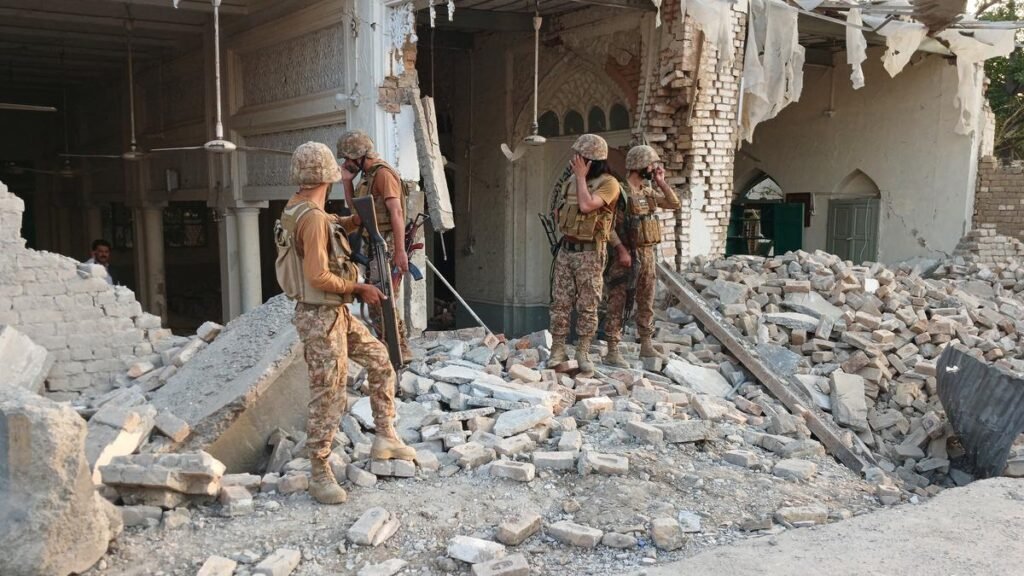
(Army personnel stand amid the rubble following an explosion inside the police headquarters at Kohat
in Pakistan’s Khyber Pakhtunkhwa province on September 18, 2026. Image Courtesy: The Hindu)
Terrorism-related Fatalities in South Asia: September
| Civilians | Security Personnel | Terrorists/Insurgents | Total | |
| India | 18 | 01 | 13 | 32 |
| Pakistan | 66 | 113 | 454 | 634 |
*includes deaths that are of unspecified category.
(i) Pakistan remains the principal centre of terrorist violence: The security situation deteriorated in Pakistan in September compared to the previous month. A total of 225 terrorist attacks occurred in Pakistan, according to the Pakistan Institute for Conflict and Security Studies (PICSS). This represented a 13 percent increase over August in which 199 attacks had taken place. Provisional data by the South Asia Terrorism Portal (SATP) revealed 634 terrorism related fatalities in Pakistan, of which 628 were from the provinces of Khyber Pakhtunkhwa (KP) and Balochistan. This included 66 civilians, 112 security force personnel and 449 terrorists. A total of 2291 terrorists have been killed this year (till September) in security force operations. Despite losing a significant number of cadres every month, the groups retain their ability to mount complex attacks against heavily protected security installations. The total number of security forces killed so far this year stands at 1046, with a kill ratio of 0.46, indicating the loss of nearly one security force personnel for two terrorists killed, an exceptionally high figure for any state dealing with terrorism. The terrorism therefore continues to have a strong security-force-centric character, although civilians too remain significant casualties.
(ii) TTP-linked violence intertwined with the Afghanistan-Pakistan security dispute: The TTP threat in September has involved a mix of tactical methods including roadside IEDs against military convoys, direct assaults on police checkpoints, and the use of drones. On 6 September, a quadcopter attack in Kohat killed a civilian. The connection between militant violence inside Pakistan and sanctuary allegations involving Afghanistan is becoming increasingly explicit. There were at least two foiled attempts of militant movements from Afghanistan into Pakistan. On 2 September, at least 15 militants were killed by Pakistani security forces during an attempted infiltration through the Ghulam Khan sector of North Waziristan. A further reported infiltration attempt occurred in Kurram on 22 September, with Pakistani sources identifying the infiltrators as TTP. Apart from relying exclusively on locally based cells, the pattern indicates continuing use of the border as an operational access route by the TTP.
Terrorism-related Fatalities in Balochistan & KP: September
| Civilians | Security Personnel | Terrorists/Insurgents | Total | |
| Balochistan | 34 | 72 | 208 | 315 |
| Khyber Pakhtunkhwa (KP) | 32 | 40 | 241 | 313 |
(iii) KP’s complex terrorism landscape: In September, the TTP’s violence, however, was overshadowed by the Ittihadul Mujahideen Pakistan, an alliance led by the Hafiz Gul Bahadar group, a former TTP commander. Formed in 2025, the IMP, which is an ally of the TTP, is considered to be extremely dangerous and combines jihadist, nationalist, and anti-Western themes for its operations. On 18 September, a vehicle-borne explosive device breached the police compound in KP’s Kohat during Friday prayers. This was followed by an armed assault on the facility killing at least 31 people, including 16 police officers. The IMP, which, like the TTP, is based in eastern Afghanistan, claimed responsibility. Pakistan, in response, conducted ground operations in KP’s Kohat and Hangu districts and, on 21 September, airstrikes against alleged militant locations inside Afghanistan. It claimed that 28 militants were killed and described some targets as TTP/associated-group facilities, including a suicide-bomber training centre. The Afghan Taliban disputed Pakistan’s account and said civilians were killed. The UN too confirmed three civilian deaths.
(iv) Convergence between Islamist militancy and separatist violence in Balochistan: In September, incidents indicated a convergence between the activities of the TTP and the Baloch insurgents. TTP activity has expanded into Pashtun-majority districts of northern Balochistan, while the Balochistan Liberation Army (BLA) continues to conduct attacks against Pakistani security personnel. On 1 September, Pakistani forces reported repelling a TTP attack on a customs facility in Pishin, while on 3 September the BLA claimed an ambush on a paramilitary convoy. The intelligence reports identified a former TTP figure, Mullah Mirajuddin Farahi, as the cross-group coordinator who transferred fighters, weapons, and money to assist the BLA, masking the operation under the BLA’s name to deflect international sanctions. The geographical convergence of Islamist and ethno-nationalist militancy, even though the two movements have different ideological and political objectives, is an additional challenge for Pakistan.
(v) Low-intensity but geographically dispersed anti-Taliban resistance continues in Afghanistan: The armed opposition to the Taliban, led by the Afghanistan United Front (AUF), National Resistance Front (NRF) and Afghanistan Freedom Front (AFF), claimed attacks in Badakhshan, Helmand, Kandahar, and Kunar. The AUF reported attacks in Badakhshan and Kandahar, the NRF reported an operation in Badakhshan on 7 September, and the AFF claimed an attack in Kunar on 8 September. The AFF claimed on 26 September to have repelled a Taliban assault on its outposts in Nuristan. It also claimed an attack in Faizabad, the capital of Badakhshan, targeting a vehicle carrying Taliban personnel near the Department of Mines and reportedly killing three Taliban members. The most notable incident came on 28 September, when the AUF claimed responsibility for an attack on the Taliban governor’s office in Ghor province. A day later, the NMF also claimed the Ghor attack, and it remains unclear which group carried it out. While none of these claims has been independently verified, the pattern suggests persistent, geographically dispersed resistance rather than a unified nationwide movement. The groups continue to rely mainly on small-scale attacks against Taliban personnel and checkpoints, although the Ghor attack shows a growing ability to strike government buildings and a presence in provinces beyond the traditional northeastern base.
Terrorism- related Fatalities in India: September
| Civilians | Security Personnel | Terrorists/Insurgents | Total | |
| Jammu & Kashmir | 00 | 00 | 05 | 05 |
| Manipur | 17 | 00 | 02 | 19 |
| Left-wing Extremism | 01 | 00 | 04 | 05 |
| Arunachal Pradesh | 00 | 01 | 00 | 01 |
(vi) Ethnic conflict in Manipur remains India’s primary vulnerability: September 2026 was a relatively low-fatality month for terrorism-related violence in India, with 29 deaths across the three theatres: 18 civilians, 11 militants and no security personnel. Manipur accounted for about two-thirds of the total, with 19 fatalities, and 17 of the month’s 18 civilian deaths occurred there. The violence was driven less by the Meitei-Kuki conflict that began in 2023 than by a cycle of Kuki-Naga clashes that, according to reports, has continued since February 2026. On 13 September, which coincided with the Kuki community’s annual “Black Day”, a couple were killed at L. Tollen village in Tamenglong district, and two more people were killed near Longpi village in Noney district. On 23 September, a private electricity lineman was shot dead while repairing a power line in Tamenglong, and about 24 houses were set ablaze in two villages in Kangpokpi. The victims were mostly villagers, women and children, and the attacks were attributed to unidentified armed groups. In J&K, five militants were killed by security forces, which points to sustained counter-terrorism pressure. The lone death of a security force personnel occurred in the northeastern state of Arunachal Pradesh on 29 September. An Assam Rifles patrol team came under attack in Changlang district along the India-Myanmar border, resulting in the death of a personnel, where border fencing work is underway. Preliminary information suspected the involvement of cadres of the National Socialist Council of Nagaland-Khaplang-Yung Aung (NSCN-K-YA).
(vii) Transnational militant infrastructure connecting Pakistan, Afghanistan, and India: The transnational militant infrastructure connecting Pakistan, Afghanistan and India continued to persist as per official assessments. On 16 September, India designated the Pakistan-based Shahzad Bhatti Network as a terrorist organisation, citing its involvement in the cross-border smuggling of arms, explosives and narcotics, recruitment and radicalisation, and dissemination of extremist material. Separately, Indian reporting also highlighted alleged efforts by the Afghanistan-based al Qaeda for Indian Sub-Continent (AQIS) to rebuild operational capabilities in Afghanistan while expanding recruitment and radicalisation activities in India. This emerging pattern points to a hybrid ecosystem involving recruitment, online radicalisation, narcotics, arms trafficking and terrorist facilitation which can pose serious security challenges to India, especially in the complete absence of regional cooperation.
(viii) Bangladesh shows early signs of militant reorganisation: Terrorism concerns in Bangladesh seem to have reemerged after a hiatus, particularly surrounding the activities of the Jama’atul Mujahideen Bangladesh (JMB) and its allied Neo-JMB group. On 18 September, Bangladeshi authorities detained 23 people suspected of involvement with JMB during a clandestine meeting at a mosque in Dhaka. The detainees were moved to the Counter Terrorism and Transnational Crime (CTTC) office for questioning. While police are still verifying their true identities, backgrounds, and exact group connections, this incident could indicate the re-emergence of clandestine militant structures, amid the new government’s widely reported soft approach to counter-terrorism, which analysts and security insiders say has sidelined experienced personnel and downplayed the militant threat since the 2024 political transition. This may have created space for JMB and Neo-JMB networks to quietly reorganise, recruit, and resume clandestine gatherings.
Projections for October 2026:
On the basis of the outlined trends, SATTP makes the following projections for South Asia for October 2026.
Pakistan: Pakistan is likely to remain the principal centre of terrorist violence in South Asia in October. The increase in attacks during September, particularly in KP and Balochistan, suggests that TTP and allied groups will retain the capacity to mount frequent attacks against police, military convoys, checkpoints and other security installations despite sustained counterterrorism operations. TTP-linked activity is likely to remain closely connected to the Afghanistan-Pakistan security dispute, with further infiltration attempts from Afghanistan and possible Pakistani retaliatory action across the border. In Balochistan, BLA activity is likely to continue, while the reported operational convergence between TTP-linked actors and Baloch separatists could produce more complex and geographically dispersed attacks.
Afghanistan: Anti-Taliban armed resistance is likely to persist at a low but geographically dispersed level. The NRF, AFF and AUF are expected to continue small-scale attacks against Taliban personnel, checkpoints and government facilities, particularly in Badakhshan, Nuristan and other areas where resistance networks have demonstrated an operational presence. The attack on the Taliban governor’s office in Ghor may encourage resistance groups to expand their activities beyond their traditional northeastern strongholds and target more prominent government installations. However, the fragmented nature of the resistance, the absence of unified command and its continued reliance on relatively small-scale attacks mean that it is unlikely to pose a strategic challenge to Taliban control during October.
India: India’s overall terrorism-related violence is likely to remain comparatively limited in October, but Manipur will remain the country’s principal internal-security vulnerability. The continuation of Kuki-Naga violence could result in further attacks on villages, civilians and local infrastructure, particularly in areas already affected by inter-community tensions. In Jammu & Kashmir, continued counter-terrorism operations are likely to constrain militant activity, although isolated encounters and attacks remain possible. India will also remain vulnerable to the wider Pakistan-Afghanistan militant ecosystem, particularly through arms and narcotics trafficking, online radicalisation, recruitment and terrorist facilitation.
Bangladesh: Bangladesh could see further indications of clandestine jihadist reorganisation in October. The September detention of suspected JMB members during a clandestine meeting suggests that dormant or weakened militant networks may be attempting to rebuild organisational structures. Further arrests, clandestine meetings and recruitment activity involving JMB, Neo-JMB or associated networks are therefore possible. However, the September evidence does not yet indicate a return to sustained high-intensity terrorist violence, and it remains to be seen whether these networks demonstrate organisational consolidation beyond isolated clandestine activity.
(South Asia Terrorism Trends and Projections (SATTP) is a monthly briefing by MISS, which tracks extremism, radicalisation, terrorism-related violence and militant activity across South Asia. Each edition combines a data-driven fatality breakdown with analysis of the month’s key incidents, emerging tactical patterns, and shifting militant dynamics, with long-view projections for the month ahead. Based on incident reporting, official statements, regional and local security sources, SATTP aims to provide readers with a clear, concise picture and prognosis of the region’s terrorism landscape and future trends. SATTP is published as part of Mantraya’s ongoing “Mapping Terror & Insurgent Networks” and “Fragility, Conflict, and Peace Building” projects.)