MANTRAYA ANALYSIS #105: 17 NOVEMBER 2026
BIBHU PRASAD ROUTRAY & SHANTHIE MARIET D’SOUZA
Abstract
Amidst prolonged civil war, weak governance, and fragmentation of territorial control, Myanmar’s drug economy has expanded, again making the country a major source of opium and synthetic drugs for regional markets. This article examines the resurgence of opium cultivation, the industrialisation of methamphetamine and ketamine production, and the growing reach of trafficking networks into Northeast India and Southeast Asia. It also highlights the illicit financial channels sustaining the trade and assesses the limitations of regional cooperation in tackling the powerful networks and beneficiaries involved.
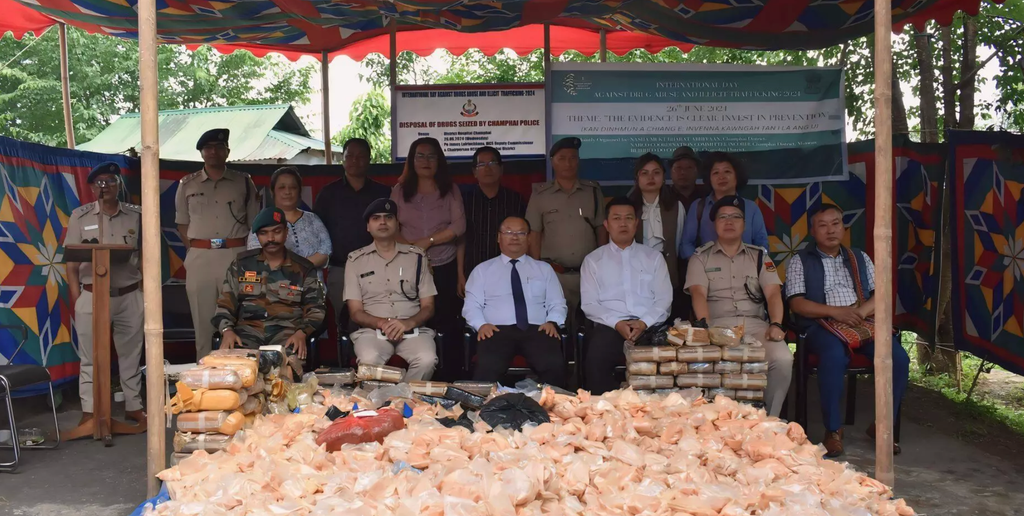
(File photo of drugs seizure in Mizoram, in 2025. Image courtesy: Mizoram Police)
Recent Seizures and Growing Threat
On 10 November 2026, the Assam Rifles, the paramilitary force which is primarily responsible for guarding the Indo-Myanmar border, seized 5.789 kilograms of methamphetamine tablets in an operation near Crossing Point-III at Zokhawthar, along the India–Myanmar border in Mizoram’s Champhai district. The seizure, valued at approximately Rs 4.69 crore, followed the interception of a suspected drug trafficker pursuant to intelligence inputs about narcotics being transported across the border.
This was not an isolated incident. On 29 and 30 October, the Directorate of Revenue Intelligence (DRI), assisted by the Assam Rifles, had seized another 50 kilograms of methamphetamine in two operations in Mizoram and Assam. The consignments included 30 kilograms of yaba pills concealed inside an office table and 20 kilograms of crystal methamphetamine hidden in tea packets above a truck driver’s cabin. Preliminary investigations indicated that the drugs had originated in Myanmar. These successive seizures, albeit paltry in an objective sense, highlight the growing scale of the synthetic narcotics trade entering India from its eastern neighbourhood.
The resurgence of opium production
The scale of Myanmar’s opium economy is illustrated by the United Nations Office on Drugs and Crime (UNODC)’s Myanmar Opium Survey 2025. According to the survey, opium poppy cultivation increased by 17 percent, from 45,200 hectares in 2024 to 53,100 hectares in 2025, the highest level since 2015. The increase was recorded across all surveyed states and regions of the country.
Year-wise opium cultivation in Myanmar (2021–2025)
| Year | Estimated area under opium poppy cultivation, in hectares | Annual change |
| 2021 | 30,160 | +2% |
| 2022 | 40,070 | +33% |
| 2023 | 47,130 | +17% |
| 2024 | 45,200 | -4% |
| 2025 | 53,100 | +17% |
Sources: UNODC Myanmar Opium Surveys, 2021–2025.
Though well behind the high point of heroin production in the mid-1990s, when the UN placed Myanmar’s raw opium output at 2,500 metric tons annually from 150,000 hectares, 70 percent of which was controlled by the legendary Khun Sa, a notorious Burmese warlord and opium kingpin, often dubbed the “King of the Golden Triangle,” who controlled a powerful armed force and dominated the region’s heroin trade for decades, drug production is advancing steadily. The steady expansion of Myanmar’s opium cultivation from 30,160 hectares in 2021 to 53,100 hectares in 2025 represents an increase of approximately 76 percent and highlights the further intertwining of civil war, economic collapse, and the illicit economy. The military coup of 2021 and subsequent escalation of armed resistance have weakened state administration, disrupted agricultural livelihoods, displaced rural populations, and reduced access to markets and public services. The conflict-affected ethnic borderlands in particular have been significantly affected. For many impoverished farmers, therefore, opium has become a relatively dependable cash crop, offering higher returns amid insecurity, debt, and the collapse of licit livelihood options.
Things looked up in 2024 with a 4 percent decline, but that did little to reverse this trend as cultivation rebounded by 17 percent to the aforementioned 2025 level. Significantly, Shan State accounted for 88 percent of national cultivation. East Shan registered a 32 percent increase, while 26 percent increase has been cited in 2025 in Chin State. Northern Sagaing, a previously opium free area, also reported cultivation of 552 hectares. This area, in particular, such as the Nanyun township, is near the border with India’s Arunachal Pradesh. These facts point to the geographical spread of cultivation into other conflict-affected areas. The breakdown of governance and territorial fragmentation seem to have created opportunities for armed groups and trafficking networks to profit from the drug economy.
The early contraction of Afghanistan’s opium production following the Taliban’s 2022 cultivation ban has increased Myanmar’s importance in the international opiate market. Although Myanmar hasn’t really replaced Afghanistan in every trafficking route or consumer market – recent reporting highlights what appears to be a surge of production in Afghanistan, as well – it is an increasingly important source of illicit opium and heroin for regional and international networks.
The Industrialisation of Synthetic Drug Production
Expansion of poppy field, of course, is not the sole metric of supply; neither is opium the only product in town. Myanmar’s illicit drug economy is in fact undergoing a significant transformation. While opium cultivation and heroin production remain important components of the country’s narcotics industry, the rapid expansion of industrial-scale synthetic drug manufacturing, particularly methamphetamine and ketamine, has changed the scale, geography, and character of the threat. Methamphetamine manufacturing was first discovered in Myanmar in the early 1990s, with the earliest known regional laboratories established around 1993 in the Wa region of Shan state. Following stricter drug crackdowns and precursor chemical controls in neighbouring Thailand, illicit manufacturers shifted their operations across the porous border into Myanmar. The first facilities were set up in the hilly Wa regions to produce methamphetamine pills mixed with caffeine, locally known as yaba or crazy medicine. Production escalated dramatically in the late 2000s as Afghanistan overtook Myanmar as the world’s primary opium and heroin supplier. By 2007, the U.S. Department of State identified Myanmar as the largest global source of methamphetamine pills, and by 2009, the UNODC confirmed major seizures of crystal methamphetamine originating from the country’s Golden Triangle region. Ketamine production is comparatively recent. Illicit ketamine manufacturing was first discovered in Myanmar around 2017–2018. Thus, while the synthetic drug industry was already expanding before the 2021 coup, the post-2021 conflict reinforced an existing illicit economy by making effective regulation and enforcement increasingly difficult.
The Shan State, particularly its northern and eastern areas bordering China, Laos, and Thailand, remains the principal manufacturing hub. The presence of established trafficking networks, access to precursor chemicals, proximity to regional markets, and limited state enforcement have all enabled production to operate on an industrial scale. China and India remain the primary origin points for the bulk chemicals used in Myanmar’s synthetic drug labs. Syndicates regularly route shipments through Thailand and Laos to bypass direct border crackdowns. Areas under the influence of different ethnic armed organisations and other armed actors have become important parts of this fragmented illicit economy.
Golden Triangle drug markets generate an estimated $75 billion to $109.7 billion annually, according to the UNODC. The Agency’s June 2026 report, Synthetic Drugs in East and Southeast Asia: Latest Developments and Challenges 2026, provides an indication of the industry’s regional expansion. Methamphetamine seizures across East and Southeast Asia reached a record 349 tonnes in 2025, an increase of 48 percent over 2024 and more than five times the quantity seized a decade earlier. Ketamine seizures increased by 185 percent to 52.5 tonnes. Thailand alone seized more than 159 tonnes of methamphetamine in 2025. The report further highlights declining retail prices in several regional markets, suggesting that growth of supply is the driver, even as ostensibly increased enforcement has yet to produce a contraction of supply. Neither is it likely to do so. In fact, Myanmar’s crystal meth prices declined in 2025 from approximately US$6 to US$5.55 per gram.
Of considerable interest, when examining the growth of illicit operations, UNODC has documented instances in which industrial-scale drug laboratories and online scam operations have operated alongside each other, sharing protection arrangements, logistics, and financial networks. In early 2026, the Myanmar military seized massive production labs in northern Shan State equipped with industrial mixing vats and chemical barrels. At the same time, however, both the military junta and various EAOs provide protection by charging “taxes” or direct patronage to these networks. This convergence has allowed the criminal organisations to diversify revenue, exploit vulnerable populations and move proceeds through complex cross-border financial systems.
Smuggling into India’s Northeast
India is particularly vulnerable because of its 1,643-kilometre land border with Myanmar, which runs through Arunachal Pradesh, Nagaland, Manipur, and Mizoram. In a statement in parliament on 29 July 2026, India’s Ministry of Home Affairs reported that drug enforcement agencies had seized 4,626 kilograms of amphetamine-type stimulants (ATS) and 2,652 kilograms of heroin between 2021 and 2025. The government specifically identified Manipur, Mizoram, and Nagaland as vulnerable to methamphetamine trafficking originating in Myanmar. The difficult terrain, forested stretches, informal crossings, and established social and commercial cross-border connections provide multiple opportunities for trafficking networks. The Moreh–Tamu corridor in Manipur and routes through Mizoram’s Champhai district have emerged as important channels for narcotics entering India.
There is also a discernible shift in the nature of trafficking. Although heroin remains a major concern, methamphetamine tablets and crystal meth are increasingly entering northeastern India. The scale of the problem was illustrated by the two seizures of 50 kilograms of methamphetamine in October 2026, cited earlier in this article. These operations followed two other major seizures of 232 kilograms and 56 kilograms of methamphetamine in the northeastern region. In the first incident, on 15 September, coordinated interceptions carried out across multiple locations in Assam and Tripura led to the seizure of 232 kilograms of meth pills, among the largest single methamphetamine busts by the DRI in northeastern India. The earlier seizure had been barely 20 days before, on 25 August. Officers searched a 12-wheeler truck travelling within a large convoy arriving from Jiribam, Manipur, at Lalpani, near the Assam-Manipur border. A thorough search revealed a specially fabricated concealed cavity built into the driver’s cabin behind the seat, which had 56 kg of meth pills packed into 56 kg of pinkish-orange methamphetamine tablets, divided into 36 brick-sized packets (1 kg each) and 100 smaller packets (200 grams each). Earlier, Indian authorities had noted the concealment of narcotics in legitimate commercial cargo, passenger vehicles, furniture, and tea consignments, all longtime tradecraft used globally.
Illicit Financial Networks
In addition to the regular seizures from low-level couriers, the attention of the agencies has been directed to the evolving illicit financial architecture that joins the demand side within India to the supply side in Myanmar, involving core financing, supply chains, and kingpins. An investigation reported by the Enforcement Directorate (ED) in October 2026 identified suspected financial flows from Indian cities towards Myanmar-based suppliers through trafficking networks in the Northeast. The agency carried out coordinated searches across Assam, Mizoram, and Manipur on 23 October 2026 under three linked money-laundering investigations that began with separate narcotics seizures. This led to the arrest of 18 accused and the detection of ₹100 crore in “hawala” transactions.
In a press release dated 25 October, the ED said it had uncovered a single, connected hawala network that carried cash from drug sales across the Northeast and beyond back to suppliers in Myanmar. One of the cases arose from a July 2026 seizure of brown sugar and cash by Churachandpur Police, which the ED says was sale proceeds collected for remittance to the suppliers. Officials say the money generated along this supply chain flows back to border towns in Mizoram, where it is settled with the Myanmar-based suppliers. The probe also reportedly found that some payments were made indirectly, in the form of essential commodities that were hard for law enforcement to detect. The ED has described this as a “drugs-for-goods” barter system, in which the syndicate has evolved to bypass traditional financial networks. The findings suggest that India’s drug trade is increasingly a problem of finance as well as border security, tied to cities far from the frontier.
Breaking the ‘Nexus’
Myanmar’s expanding drug economy is no longer simply a counter-narcotics problem. It is becoming an integral part of the political economy of conflict, sustaining criminal networks, undermining governance, and creating mutually reinforcing relationships between armed actors and transnational syndicates. The resurgence of opium cultivation alongside the industrialisation of synthetic drug production has transformed the Golden Triangle into an increasingly consequential centre of the regional illicit economy. For India, the threat extends well beyond repeated seizures along the Northeastern frontier to include the penetration of domestic markets, the consolidation of cross-border trafficking networks, and the emergence of sophisticated financial channels linking Indian cities with suppliers in Myanmar. For Southeast Asia, the sheer scale of drug production and trafficking risks further entrenching organised crime, corruption, and instability.
Addressing this challenge will require more than just increased border surveillance and seizures. India and its regional partners will have to prioritise intelligence sharing, coordinated financial investigations, controls on precursor chemicals, and actions against the financiers and protection networks that support the trade. More crucially, supply is unlikely to be impacted in the absence of development efforts that make illicit employment attractive. The actual state of cooperation between India and Southeast Asian countries is evolving but remains stronger in institutional arrangements and operational enforcement than in sustained disruption of the financial and political networks behind the drug trade, much less in cooperation to deal with the societal roots of the challenge.
In this sense, suppression is an unlikely winner. Instrumentally, the current central weakness is not so much the absence of cooperation frameworks but their limited capacity to translate information exchange into coordinated cross-border investigations, asset seizures, and action against the powerful actors who protect and profit from the trade. Developmentally, there will be no decline in production as long as it makes perfect sense at the local level to engage in such activity. If Myanmar’s conflict-driven illicit economy is not addressed alongside its regional supply chains, drug seizures will only be tactical successes against a criminal enterprise that continues to grow.
(Dr. Bibhu Prasad Routray is the Director of MISS. Dr. Shanthie Mariet D’Souza is the Founder & Executive Director of MISS. This analysis is part of Mantraya’s ongoing “Fragility, Conflict, and Peace Building” projects. All MISS publications are peer-reviewed.)