MANTRAYA ANALYSIS #96: 14 APRIL 2026
BIBHU PRASAD ROUTRAY & SHANTHIE MARIET D’SOUZA
Abstract
Despite the Indian government’s highly publicised zero-tolerance policy against narcotics, the smuggling of banned substances into India, particularly from sources like Pakistan, continues unabated. Seizures and interceptions have increased, and so have the incidents of drug smuggling, along with the sophisticated modus operandi. Although the capacities of security agencies have improved over the years, they have struggled to keep pace with the rising number of incidents, which are clearly linked to changes in the profile of drug manufacturing in Afghanistan and the state of relations between India and Pakistan.
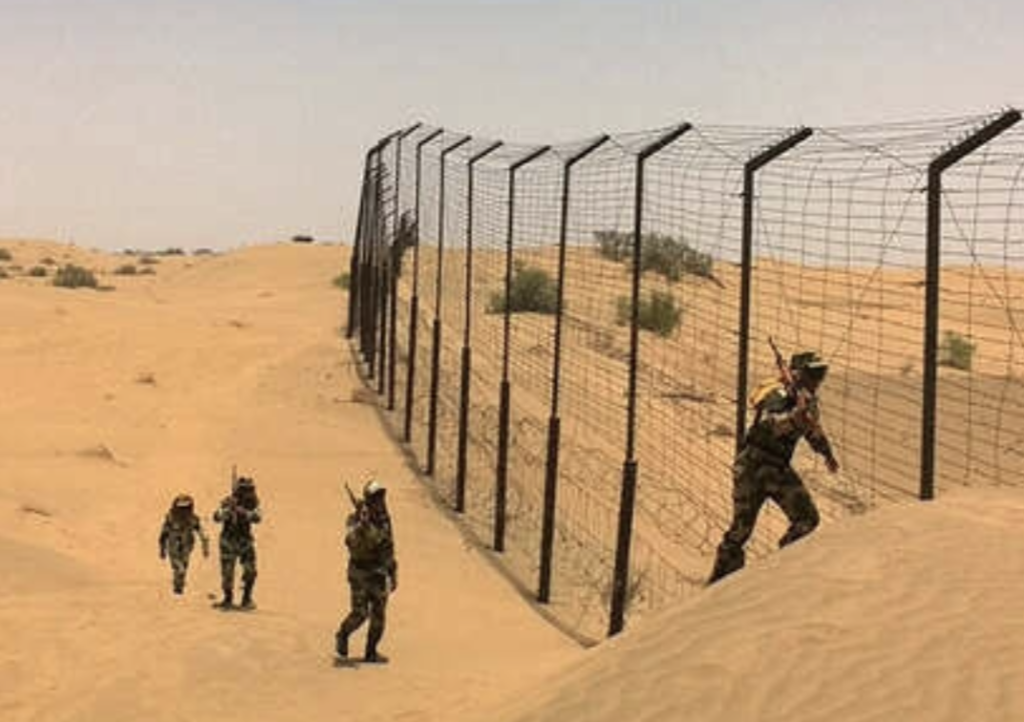
(India’s Border Security Force (BSF) personnel patrolling the India-Pakistan border in the Thar desert region)
Rising Incidents
On 7 April, the arrest of two Indian nationals and the recovery of five kilograms of methamphetamine from them may have led to the discovery of yet another drug smuggling network involving Pakistan and India. A joint operation by the Gujarat and Rajasthan anti-terrorism squads (ATS) caught the two who had collected a drug drop in Barmer district of Rajasthan from Pakistan’s Tharparkar district in the Thar desert region and were on their way to deliver them for onward distribution.
Below is a sampling of similar incidents, in the states of Rajasthan and Punjab, that point to an organised effort to push banned substances with a bid to generate resources, some of which are likely to be used to aid terrorism in India.
On 8 April, police in Phagwara (Punjab’s Kapurthala district) arrested four persons, including a woman, and recovered 16.8 kilograms of heroin from their possession. In this case, these persons were acting as conduits of Pakistan and Dubai-based handlers. The consignment had been dropped off at the India-Pakistan border area in Amritsar with the instruction of delivery in Chandigarh.
In February 2026, an army man, a dismissed Punjab Police personnel, and two women were among six people arrested, and 4.8 kilograms of heroin were recovered in Punjab’s Faridkot. Here too, Pakistani handlers who had dropped the consignment using a drone were involved. The arrested army man and the police personnel had used their official ID to pass through checkposts and evade search.
In September 2025, the Faridkot police in Punjab recovered 12.1 kg of Heroin and arrested two drug smugglers. Here too, arrested persons were in contact with Pakistan-based smugglers, who had sent the illicit consignment across the border to be kept in the home of one of the arrested persons in Jhariwala, a medium-sized village in Faridkot with a population of about 900, and to be moved onwards at a convenient time.
The Pipeline through Thar
The Barmer drug interception incident underscores the ongoing issue of drug smuggling through the Thar Desert region, a problem that has persisted for decades. In Rajasthan, the districts of Sriganganagar, Bikaner, Jaisalmer, and Barmer share borders with Pakistan and are characterised by a vast, rural landscape filled with numerous small villages. For example, Barmer district has approximately 2,900 villages, of which around 50 are located along the border.
Many smugglers in this area have inherited their trade from previous generations and use the sparsely monitored vast deserts to transport drugs across borders. These individuals, who act as receivers and couriers, often serve as crucial connections between the Pakistani networks and Indian kingpins in Punjab and Delhi. In recent years, their methods have become increasingly sophisticated.
In October 2025, the Rajasthan Anti-Narcotics Task Force (ANTF) arrested an individual from Satliya village in Barmer. His profile matched the modus operandi of many others in the region involved in receiving and forwarding drugs from Pakistan. This person followed in his father’s footsteps, who had been arrested for the same activities. After his father’s arrest, he took over the operation and expanded it through new routes in Jaisalmer, Bikaner, and Punjab. For several years, he collected heroin packets that were thrown across the border, storing them until he could hand them over to syndicate leaders in Punjab and Delhi. The packets were typically tossed over the border fence, and he would retrieve them under the pretence of grazing camels. For each packet he collected and delivered to the kingpins in Punjab and Delhi, he earned a commission of 100,000 rupees.
Drone Drops
Such manual dropping methods, however, have undergone significant changes with the use of drones. According to India’s Narcotics Control Bureau (NCB), whose latest data pertains to the year 2024, drone-driven drug drops along the India-Pakistan border have increased from a mere three in 2021 to 179 in 2024. Neither Kapurthala nor Fairdkot shares an international border with Pakistan. But they share borders with Gurdaspur, Amritsar, Tarn Taran, Ferozepur and Fazilka districts, which are border districts. Of these, the first four have witnessed significant drone-driven drug smuggling cases. “There has been a sharp increase in drone sightings and recoveries of narcotics in border districts such as Amritsar, Tarn Taran, Ferozpur, and Gurdaspur”, the NCB’s annual report 2025 informs. The packets dropped by drones are identified by hooks attached to them, some of which are still intact at the time of recovery by the Indian smugglers.
The fact that drone drops have indeed increased is supported by the fact that 18 incidents of drone-based drug smuggling have occurred in the Karanpur sector of Sri Ganganagar district of Rajasthan in the past 3 years. Three consignments of heroin were recovered on consecutive days between 5 and 7 April by the Border Security Force (BSF) and the state police personnel. The drop on 7 April consisted of two packets of heroin, weighing about 1.560 kilograms. On 6 April, three packets weighing 2.340 grams had been recovered. On 5 April, 12.167 kilograms of heroin were recovered from the Rohi area of village 23 O. Since no one had picked up these packets, no arrests have been made in these incidents, although there is bound to be an organised cross-border network. A total of 10 persons have been arrested in connection with past cases.
The recovered consignments are mostly heroin and opium, and of late, as the arrest in the 7 April incident reveals, include methamphetamine. While the NCB does not guesswork about the real origin of these drugs, the Golden Triangle area (Laos, Thailand and Myanmar) has been the usual source for meth tablets. The Golden Crescent area (Afghanistan, Pakistan and Iran) supplies mostly heroin, ATS (Amphetamine-Type Stimulants) and hashish. Since 2023, the Indian government has started using the terms Death Crescent and Death Triangle in place of Golden Crescent and Golden Triangle. The NCRB, being a government agency, follows the same terminology. The recovery of meth tablets in the western state of Rajasthan is a pointer to the new trend of the Golden Crescent’s switchover to meth production, mostly after the Taliban banned poppy cultivation in Afghanistan, post-2021.
The modus operandi in most such cases of smuggling involves communication using WhatsApp chats and videos between the Pakistani handlers and the Indian couriers who connect in the darknet markets. The payment is usually through cryptocurrencies. Between 2020 and 2024, the NCB registered 96 such cases involving the darknet and cryptocurrencies.
Conclusion
New Delhi’s ‘Zero Tolerance Policy against Narcotics’ employs two strategies to address both the supply and demand for drugs. While the arrests of Indians involved in the cross-border smuggling network are a significant step, they only address part of the issue. Due to the lack of cooperation between India and Pakistan, New Delhi faces challenges in tackling the rising drug problem within its own borders. Given the geography and vastness of the India-Pakistan border, along with various complexities, completely eradicating the issue through this approach is not feasible without a substantial allocation of resources to curb such activities at entry points.
Additionally, India needs to focus more on addressing the source of drugs in Afghanistan. With improved relations with the Taliban, who have shown a willingness to combat the drug problem within their territory, there is potential for establishing an India-Afghanistan cooperation mechanism.
(Dr. Bibhu Prasad Routray is the Director of MISS. Dr. Shanthie Mariet D’Souza is the Founder & Executive Director of MISS. This analysis has been published as part of the ongoing “Organised Crime & Illicit Trafficking” and “Fragility, Conflict, and Peace Building” projects. All MISS publications are peer-reviewed.)