MANTRAYA SPECIAL REPORT#26: 15 APRIL 2026
JAIDEEP SAIKIA & SHANTHIE MARIET D’SOUZA
Abstract
The United Liberation Front of Asom (Independent) ULFA (I) has reconfigured from a localised insurgency into a sophisticated, networked non-state force, utilising a five-fold architecture of resilience that includes external patronage and technical modernisation. This strategic evolution, characterised by Chinese tactical backing and operational autonomy, has empowered the group as a potent state proxy, fundamentally altering the security dynamics within the North East Indian corridor. This paper probes the evolution, tactics, external linkages, sanctuary and technological availability that the ULFA (I) has used as a force multiplier with concomitant security, strategic and geopolitical challenges for India.
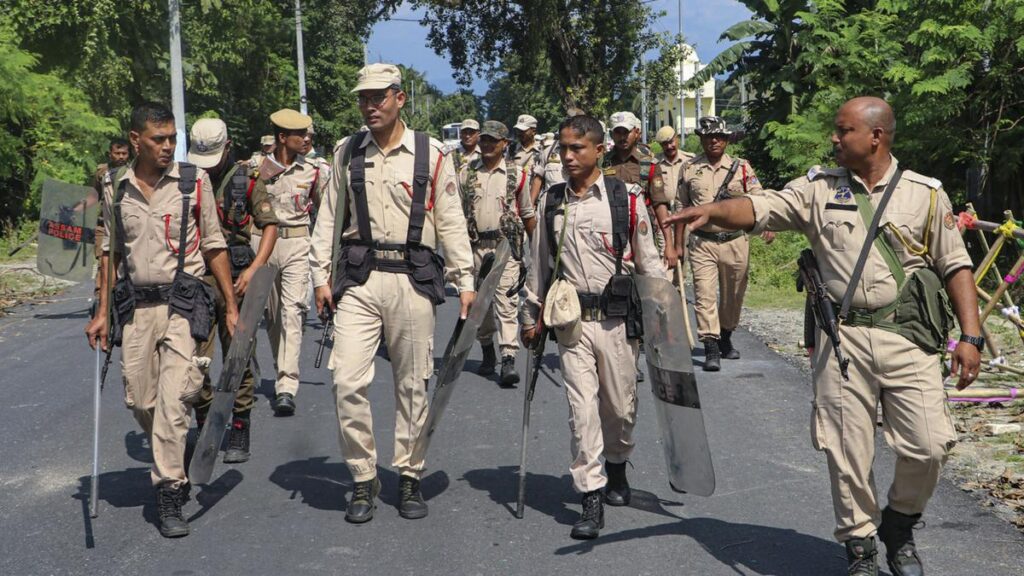
(Photo Credit: The Hindu)
The Resurgence
The resurgence of the United Liberation Front of Asom-Independent (ULFA-I)[1] represents a quintessential case study in the blurring of lines between war and politics,[2] combatants and civilians, and the local and the transnational.[3] Far from being a shrunken relic of Cold War era ethno-nationalism, the outfit’s contemporary rebound is a sophisticated “system-level” response,[4] triggered when specific geopolitical and psychological variables have achieved a state of symbiotic alignment.[5]
A close reading of history reveals that what was termed a low-intensity conflict is actually traditional rebellion informed by ideologically privileged violence, including attacks on innocent people for political reasons, thereby making a case for terrorism rather than insurgency. The latter avoids foregrounding violence in favour of mass mobilisation through appeal to greed and grievance.[6]Analysis of the current conflict suggests that insurgent persistence is less about popular grievance[7] and more about the technical availability of external sponsorship and territorial sanctuary.[8]
The strategic “bounce back” is predicated upon a five-fold architecture of resurgence. First, the provision of a high-end logistical and digital safe haven within the Yunnan Province of China provides the group with a “sovereign shield,” facilitating the transition from a jungle-bound militia to a technocratic proxy of the People’s Republic’s Ministry of State Security (MSS).[9] Second, the enduring “black holes” of sovereignty in Myanmar’s Sagaing and Kachin states offer a permanent kinetic laboratory for training and tactical evolution of such rebel groups. Third, the failure of the Indian intelligence community to achieve a “decapitation strike” against the core leadership—most notably the elusive chief Paresh Barua—has allowed for the institutionalisation of command and control[10]. Fourth, this resilience is fuelled by Barua’s own megalomaniacal psychological profile. That is, his ideological alignment with the cult of “absolute resistance” is best evidenced by his profound eulogy for LTTE’s Vellupillai Prabhakaran in the Asomiya Pratidin,[11] signalling a commitment to a “fight-to-the-death” doctrine that transcends traditional political compromise. Finally, the ouster of the Awami League in Bangladesh[12] has restored the “strategic depth” of the 1990s. The present state of affairs in the erstwhile East Pakistan could witness a return to a permissive environment in Bangladesh.
In the calculus of modern insurgency, when the ingredients of external patronage, territorial sanctuary, and fanatical leadership converge, the result is not merely a rebound, but a sophisticated reconfiguration of the regional battlespace. The following analysis examines the five pillars of this resurgence, detailing how a combination of tactical loss, political opportunism, and advanced weaponry has reshaped the “battlespace” of North East India.
The 2025 Drone Strikes: Retribution as a Catalyst
On 13 July 2025, a series of precision drone strikes targeted ULFA(I) encampments along the Myanmar-India border. While these strikes successfully eliminated several high-ranking senior ULFA (I) leaders, including Nayan Medhi, Ganesh Lahon, and Pradip Gogoi, the unintended consequence was the “martyrdom effect.”[13] Rather than decapitating the movement, these strikes served as a powerful recruitment and mobilisation tool.
The loss of veteran commanders cleared the path for a younger, more technologically savvy group of cadres that viewed drone warfare not just as a threat but as a blueprint. This “Retribution Phase”[14] has witnessed the ULFA(I) shifting from traditional guerrilla ambushes to asymmetric, standoff attacks, signalling a transition from a jungle-bound insurgency to a modern, networked paramilitary force.
The Bangladesh Pivot: The Ouster of Sheikh Hasina
The geopolitical “breather” for the ULFA(I) arrived with the dramatic ouster of the Awami League government in Bangladesh in August 2024. Under Sheikh Hasina, Dhaka maintained a policy of “zero tolerance” toward Indian insurgent groups, leading to the arrest and deportation of several top leaders. With the shifting political tides and the rise of the Bangladesh Nationalist Party under Tarique Rahman, the environment might have turned permissive again. Reports indicate that legal cases against Paresh Barua for his role in the 1 April 2004 Chittagong Arms case have been commuted,[15] reopening the door for the re-establishment of safe houses and logistical bases within Bangladeshi territory.
This restores the “strategic depth” that the ULFA(I) had lost over a decade ago, complicating India’s security perimeter. The undivided ULFA had a robust armed battalion (109 Bn) in Sherpur, and reports indicate[16] that residual elements in West Garo Hills, Goalpara, and adjoining areas may witness reactivation if the ULFA (I) decides to return to Bangladesh. Incidentally, Paresh Barua’s family (wife and two sons) continues to be residents of Dhaka, as Bangladeshi citizens.
Operation Bujoni: The RPG-7V2 and Technical Sophistication
The tactical evolution of ULFA(I) was laid bare during a daring attack on 21/22 March 2026, Operation Bujoni (Operation “Teach-a-Lesson”).[17] The deployment of RPG-7V2 anti-tank grenade launchers—a significant upgrade from older models—demonstrated both sophisticated firepower and advanced training.
The RPG-7V2 allows for greater accuracy and the use of tandem-charge warheads capable of penetrating modern armoured personnel carriers. The successful execution of Operation Bujoni suggests that the ULFA(I) may have incorporated “target-specific destruction” tactics, implying a level of military drilling that matches conventional infantry standards and possibly needs external guidance.
Paresh Barua: The New Arms Mogul of South Asia & the Yunnan nexus
In a YouTube interview, former rebel-turned-social worker Jiten Dutt characterised Paresh Barua not merely as a militant leader but as the “new arms mogul” of the region.[18] Barua has successfully exploited the chaos in post-coup Myanmar[19] to tap into international black markets or the Hei Shehui. By positioning the ULFA(I) as a middleman in the flow of sophisticated weaponry—ranging from MANPADS (Man-Portable Air-Defence Systems) to specialised sniper systems—Barua has secured a steady stream of revenue. This financial independence allows the outfit to bypass traditional extortion-based funding, making them more resilient to local counterinsurgency pressure.
The strategic entrenchment of Paresh Barua within Yunnan Province of China represents a qualitative shift from mere “sanctuary” to a sophisticated logistical hub of the Ministry of State Security (MSS). Operating under the tactical umbrella of the MSS’s regional intelligence apparatus, Barua has transitioned into the role of a high-level procurement intermediary, facilitating the flow of Chinese-origin Norinco[20] weaponry—including the RPG-7V2 and man-portable air-defence systems (MANPADS)—to the fractured battlespaces of Myanmar and North East India.
This “Yunnan Nexus” leverages MSS-protected financial channels and dual-use cross-border infrastructure, allowing Barua to function as the preeminent arms mogul of the sub-region. By providing technical end-user certificates and shielding their kinetic operations from Indian intelligence, the MSS has effectively transformed ULFA(I) and other Indian insurgent groups such as the PLA (Manipur) into asymmetric state proxies, ensuring they remain the primary arbiters of sophisticated fire-power in the South Asian corridor.
The procurement pipeline facilitated by the Yunnan corridor has shifted from basic small arms to a sophisticated suite of “force multipliers” that bridges the gap between guerrilla tactics and conventional warfare. Under the technical guidance of the MSS, the inventory managed by Paresh Barua and Manohar Mayum of the PLA (Manipur) now features specific high-end military hardware designed to counter the Indian Army’s tactical advantages. These include precision anti-armour systems such as the RPG-7V2 (Russian-designed, Chinese-manufactured as the Type 69-1). This has emerged as the centrepiece of current ULFA(I) operations such as the aforementioned Operation Bujoni. Unlike older variants, these are equipped with PGO-7V3 optical sights, enabling high-accuracy strikes against hardened bunkers and Mine-Protected Vehicles (MPVs).
Unconfirmed reports also indicate the presence of FN-6 (Fei Nu-6) MANPADS. These infrared-homing missiles provide a critical “anti-access/area denial” (A2/AD) capability, specifically targeting Indian helicopter-borne logistics and casualty evacuation (CASEVAC) operations in the dense jungle terrain of the Indo-Myanmar border. The MSS has reportedly facilitated the supply of high-grade SDR (Software Defined Radios) and satellite communication terminals that utilise military-grade frequency-hopping spread spectrum (FHSS) technology. This makes ULFA(I) and PLA (Manipur) communications largely resilient to the Indian Army’s electronic warfare (EW) and signal interception efforts. Captured caches have increasingly included Gen-3 Passive Night Sight (PNS) devices and thermal imaging monoculars. This hardware nullifies the traditional “ownership of the night” long held by elite Indian counter-insurgency units like the 21 Para (Special Forces).
This influx of hardware, often routed through the United Wa State Army (UWSA)[21]—a primary MSS proxy—ensures that the “Arms Moguls” maintain a technological parity that complicates any traditional kinetic response.
The VanDyke Factor and the Mercenary Battlespace
The most concerning development is the “internationalisation” of the regional conflict. Despite official assurances from the Indian Home Ministry that the VanDyke’s group[22] posed no direct threat to India,[23] the reality on the ground suggests a restructuring of the battlespace. Mercenaries and technical advisors are increasingly active in training Myanmarese Ethnic Armed Organisations (EAOs), such as the Arakan Army and the KIA.
It is worth noting that this is a long-established dynamic, with mercenaries and adventurers in small numbers having, since the early post-Vietnam War years made their way to engage in interactions with the various Myanmar ethnic groups against the state during those regular periods of dictatorship, which saw Yangon attempt to eliminate this longstanding challenge to Burman supremacy.[24] Migration of this phenomenon to South Asia has long been predicted, particularly given the spillover caused by the Burmese genocidal campaign conducted against the Rohingya and the consequent spillover of its numerous second-order consequences to not only Bangladesh but also the Indian North East.
Contract expertise now could be “bleeding over” to Indian groups like ULFA(I), PLA (Manipur), and NSCN (KYA) through shared tactical alliances. These groups are no longer just “rebels” but are becoming “hybrid actors” capable of executing sophisticated electronic warfare, encrypted communications, and coordinated multi-group offensives.
Alternate Pathways
To counter the sophisticated, multi-front resurgence of the ULFA(I) and the broader external nexus, New Delhi needs to pivot from traditional kinetic containment to an asymmetric, “whole-of-domain” strategy. The following recommendations are put forward for the Indian state.
- “Grey Zone” digital disruption of the Yunnan Supply Chain
Rather than targeting the hardware once it crosses the border, India should deploy offensive cyber capabilities to disrupt the MSS-protected digital logistics in Yunnan. Such an operation can be launched by a sustained cyber-sabotage campaign against the digital manifests and financial clearinghouses used by Paresh Barua and Manohar Mayum. By introducing “ghost data” into their Norinco procurement chains or freezing the crypto-wallets used for mercenary payments, India can induce an “information deficit” between the insurgents and their sponsors without firing a shot.
- Operationalise “Private Military Diplomacy” in Myanmar
If mercenary VanDyke-like groups and other Western contractors are already present in the battlespace, New Delhi needs to view them as a purely legal threat and start viewing them as potential geopolitical leverage. An alternative course of action is to establish “deniable” backchannels with Western Private Military Contractors (PMCs) operating in Myanmar’s Chin and Sagaing states. By offering intelligence or logistics in exchange for their cooperation, India can ensure these mercenaries act as “inhibitors” to the ULFA(I)’s movements rather than as trainers for Indian insurgents.
- Establish a Trans-National Truth & Reintegration Agency in Dhaka
With the ouster of Sheikh Hasina and the return of Tarique Rahman, India needs to rely beyond high-level diplomacy to prevent Bangladesh from becoming a base again. This is even though there has been a level of assurance by the Tarique Rahman regime that Bangladesh would not allow its soil to be used against India. The prudent course of action would, therefore, be to create an autonomous “Track 1.5” agency that works directly with Bangladeshi civil society and the top-tier bureaucracy to highlight the economic cost of hosting the ULFA(I). By funding local transparency initiatives that track “insurgent-linked real estate” in Dhaka, India can make hosting Paresh Barua a political liability for the new regime, regardless of its ideology.
- Erection of an “Active-Kill” electronic canopy
The deployment of “Swarm-Deterrence” infrastructure along the India-Myanmar border has become a necessity. Since the 2025 drone strikes proved that traditional border fencing is obsolete against standoff retribution, India can shift to an “Active-Kill” electronic canopy. Instead of just patrols, the employment of low-altitude microwave and laser mesh along critical infiltration corridors is critical at this juncture. Such an “Electronic Wall” would automatically neutralise any non-coded UAV or RPG-7V2 guidance system entering Indian airspace, rendering the sophisticated hardware coming from Yunnan technically inert the moment it crosses the border.
- Weaponise “Insurgent Factionalism” via Information Warfare
The label of an “Arms Mogul” is a double-edged sword that can be used to alienate the leadership from the rank-and-file. Launching of sophisticated psychological operation targeting the lower cadres of the ULFA(I) whereby data showcases the luxurious “Yunnan lifestyle” of Barua compared to the “jungle misery” of his cadres and by highlighting Barua as a “Chinese-funded capitalist” rather than a “liberator,” the potential of internal mutinies that disenchantment could impinge on the morale of the existing and potential cadres.
Prognosis
The “New ULFA” is a product of a perfect geopolitical storm and the lack of long-term security planning and architecture to prevent such re-emergence. The intersection of high-tech retribution, permissive regional politics, and professionalised mercenary training has created a security vacuum that threatens to undo decades of relative peace in North East India. For New Delhi, the challenge is no longer just managing a local insurgency but countering a sophisticated, transnational military network that views the border as an obsolete concept.
It is thus not helpful to conceptualise distinct security, development, and political strategies when the imperative is to identify linkages between them. Each of these pathways constitutes an approach, a line of effort, that is part of the broad strategy required to defeat extremism of any form. Security will always be the initial instinctive response of the state to outbreaks of non-state violence. There are understandable reasons as to why this is the case, not least because security is likely to be the most urgent demand of the targeted populace. Less visible, but no less important, though, are activities such as gathering actionable intelligence, interdicting attacks, pacifying areas, and specific targeting of key violent militants. All of this collectively constitutes some of the most obvious lines of activity necessary for countering non-state action.
END NOTES
[1] The United Liberation Front of Asom was formed on 7 April 1979. The banned insurgent organisation split into two factions, with its chairman, Arabinda Rajkhowa, and several members of its executive council consenting to hold dialogue with the Government of India in 2012. This followed the handing over of almost the entire present pro-talk group leadership led by Rajkhowa to India by Bangladesh under the Sheikh Hasina regime in 2009. The anti-talks faction headed by Paresh Barua came to be known as the ULFA (Independent).
[2] Oscar Jonsson, The Russian Understanding of War: Blurring the Lines between War and Peace (Washington, DC: Georgetown University Press, 2019).
[3] Jaideep Saikia and Ekaterina Stepanova (eds.), Terrorism: Patterns of Internationalisation (New Delhi: Sage Publications, 2009).
[4]Steven Metz, andRaymond Millen, Insurgency and Counterinsurgency in the 21st Century: Reconceptualising Threat and Response (Carlisle, PA: Strategic Studies Institute (SSI), US Army War College, 2004).
[5] Philip Smith, “Codes and Conflict: Toward a Theory of War as Ritual,” Theory and Society 20, no. 1 (1991), 103–138.
[6] “Understanding insurgencies and violent extremism in South and South East Asia” in Shanthie Mariet D’Souza (ed). Countering insurgencies and violent extremism in South and South East Asia”, (UK: Routledge), January 2019.
[7] The ULFA (Independent) has almost no popular support among the Assamese people at the time of writing in April 2026, and its strength (according to intelligence reports) has dwindled to about 200 cadres.
[8] The ULFA (Independent) has six camps in Myanmar, including Arakan, Papung, and Jokham camps.
[9] Paresh Barua is reportedly billeted in Tinsum County, Prefecture 20 in China’s Yunnan province. The Chinese intelligence organisation, the Ministry of State Security, reportedly chaperones Barua.
[10] The ULFA (I) has several important second-rung leaders, including Michael Deka Phukan and Saurav Asom.
[11] Asomiya Pratidin issue dated 23 May 2009. Velupillai Prabhakaran was killed by the Sri Lankan army on 18 May 2009 during the final phase of the Sri Lankan Civil War.
[12] Sheikh Hasina and her political party, the Awami League, were ousted on 5 August 2024.
[13] The ULFA (I) has stated that it will exact revenge for the drone strikes. See https://youtu.be/w0Cr53PoYTM?si=ye-9i5L45peyVJJx
[14] The ULFA (I) attacked an Indian Army camp at Kakopathar in Tinsukia district on 16 October 2025, injuring three soldiers. Later, on 22 March 2026, they launched a Rocket Propelled Grenade (RPG) attack on the Assam Police Commando Battalion stationed at Jagun in the same district.
[15] Kallol Bhattacharjee,“Bangladesh Court Commutes ULFA Chief Paresh Barua’s Death Sentence to Life Term,” The Hindu [New Delhi], 18 December 2024.
[16] Travels to the area by one of the authors, Jaideep Saikia.
[17] Ibid.
[18] https://youtu.be/ePOUuTH0Blk?si=_KGyF2eNMHIKo1gp (accessed on 3 April 2026).
[19] The military seized power in Myanmar on 1 February 2021.
[20] Norinco (China North Industries Group Corporation Limited) is a primary Chinese state-owned defence corporation manufacturing military products, including sophisticated weapon systems and drones.
[21] https://www.moderninsurgent.org/post/united-wa-state-army (Accessed on 4 April 2026).
[22] An American mercenary and founder of “Sons of Liberty International,” Matthew VanDyke, was apprehended by India’s National Investigation Agency on 13 March 2026. He was detained at the Kolkata airport under the Unlawful Activities (Prevention) Act. Six Ukrainian nationals were also arrested for allegedly training Myanmar-based Ethnic Armed Organisations near the India-Myanmar border. See also Subir Bhaumik, “Matthew VanDyke Reveals US-based Mastermind Behind Hiring Mercenaries in Myanmar,” The Federal, 27 March 2026.
[23] https://www.instagram.com/p/DWbM7Qlgark/ (Accessed on 2 April 2026).
[24] Lance Motley, connected to Soldier of Fortune magazine, was a typical example (https://www.west-point.org/users/usma1979/36792/). A West Pointer killed on 30 May 1989 while fighting with the Karen against the regime, he and others regularly entered Myanmar in various unofficial capacities.
(Jaideep Saikia is an Assam-based author and conflict theorist. Dr. Shanthie Mariet D’Souza is the Founder & Executive Director of MISS. This special report has been published as part of Mantraya’s ongoing “Fragility, Conflict and Peace Building” and “Mapping Terror & Insurgent Networks” projects. Opinions expressed here are those of the authors. All Mantraya publications are peer-reviewed.)