MANTRAYA SPECIAL REPORT#27: 26 MAY 2026
QUDRATULLAH YOUSOFI
Abstract
Kabul faces a severe and accelerating water crisis driven by four decades of conflict, rapid unmanaged urbanisation, governance failures, and climate change. Groundwater levels are declining by roughly 5 metres annually, nearly half of all borewells have run dry, and contamination from arsenic, sewage, and toxins threatens public health. Only 20 per cent of households have access to piped water, forcing millions to rely on costly and unreliable alternatives. Without an immediate and coordinated intervention by the Islamic Emirate and the international community, Kabul will run out of water by 2030.
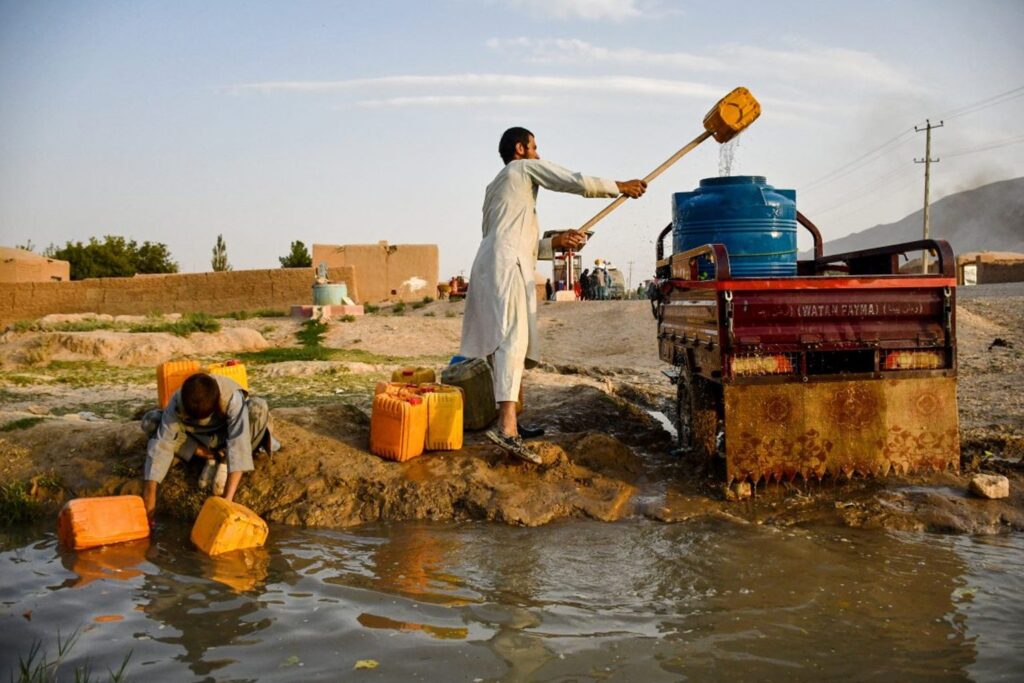
(Image Courtesy: Hasht e Subh Daily)
Introduction
Kabul, the capital of Afghanistan, is situated in the eastern part of the country. A vast valley borders it, and the Hindu Kush Mountain lies on its southeastern side. It is a landlocked city, surrounded by no water bodies. Six provinces border it: Parwan to the northwest, Kapisa to the northeast, Laghman to the east, Nangarhar to the southeast, Logar to the south, and Wardak to the west. Its population stands at approximately six to seven million people. The city is confronted with a patchy water shortage caused by seasonal water flow from the Logar, Paghman, and Kabul rivers into the Kabul River during snowmelt and rainfall. Major sources of Kabul’s water are snow and glacier meltwater from the Hindu Kush mountains.
The water crisis in Kabul is not a sudden development. It is the product of decades of conflict, governance failures, rapid urbanisation, and climate pressures. Understanding its trajectory — from its historical roots, through the acute present reality, to the uncertain future — is essential to grasping both its scale and crafting effective responses.
A. The Past — Historical Roots of the Crisis
Nearly 40 years of civil war damaged Afghanistan’s natural resources, infrastructure, water systems, land, and agricultural sector. About 80 percent of Afghans rely on the agricultural sector, making water scarcity a crisis that extends far beyond the capital. Nationally, the negligence of both successive governments — the Republic and the Islamic Emirate — played a crucial role in the intensification of the water crisis in Kabul.
The Qargha dam, built in the 1930s and located 16 kilometres west of Kabul, is among the oldest water infrastructure in the city. Standing at 30 metres in height, it provides water to residents of the western districts of Kabul. However, water depletion in this dam made 12,000 hectares of land useless, and approximately 500,000 agricultural jobs were placed in jeopardy by 2025. Currently, only 50 percent of Qargha’s reservoir is functional; the rest suffers from poor conservation and sedimentation.
In the 1990s, borewells became widely known to Kabulis as an alternative water source. Later, in the mid-2010s, solar-powered pumps were introduced for water provision. By mid-2010, groundwater levels were already at 100 metres in many areas; within a few years, that depth rose to nearly 300 metres in some locations. In 2006, the World Bank confirmed a $40 million water project intended to link 50 percent of households to a unified water distribution system by 2010 — a goal that was never fully realised.
(i) Rapid Population Growth and Unmanaged Urbanisation
Between 2001 and 2025, Kabul’s population increased from 1 million to approximately 6 million people. This rapid and largely unmanaged urban growth placed immense pressure on the city’s already strained water resources. Kabulis dug almost 120,000 wells, built hundreds of firms and greenhouses, and large numbers of people migrated from rural regions to Kabul. The movement of a high number of households from the countryside to Kabul, compounded by the deportation of a large number of households from neighbouring countries, Iran, Pakistan, and Tajikistan, further strained water availability.
In 2008, Oxfam International revealed that a lack of water caused interpersonal conflicts among households, with 40 percent of these disputes attributed to water shortage. That same year, the scope of the problem was already apparent to international observers, yet concerted action remained elusive. The Baghrami water reservoir, the largest in Kabul, was built by the United States of America and supports 250,000 citizens; it was later updated by the International Committee of the Red Cross (ICRC) in 2024.
(ii) International Engagement and Its Limits
The international community invested heavily in water infrastructure during the republic era. According to the World Bank, foreign donors supported the republic government with more than $4 billion for its water crisis alone. International organisations such as the Deutsche Gesellschaft für Internationale Zusammenarbeit (GIZ), from 2008 to 2021, and Kreditanstalt Für Wiederaufbau (KFW), from 2017 to 2020, planned to entirely solve Kabul’s water crisis. Despite this investment, Kabulis continued to face water shortage, pointing to systemic failures in implementation and coordination. The United Nations International Children’s Emergency Fund (UNICEF) and the Danish Committee for Aid to Afghan Refugees (DACAAR) found that lack of coordination between the government and the international community was a primary reason behind the persistence of the water crisis.
B. The Present — An Acute and Deepening Crisis
Kabul is presently in the grip of a water crisis of alarming proportions. In the last ten years, there has been a drawdown of approximately 25 to 30 metres in the groundwater level. Based on the United Nations (UN), about 50percent of borewells have lost their water. In 2023, the United Nations Office for the Coordination of Humanitarian Affairs (UNOCHA) reported that 51 percent of borewells are watery, while 40 percent are useless. Currently, wells must be dug to depths of about 100 to 150 metres to produce water. Based on Ghulam Rahman Kazim, head of the state-run water and wastewater company, there were nearly 82 water sources in Kabul; currently, only 38 of them are active.
In the Kart-e-Char region of Kabul, several years ago, a 40-metre borewell could fulfil water requirements. A few years ago, that depth rose to 90 metres. Recently, the water level has grown deeper still, reaching an unpredictable level. The groundwater level is drawing down at approximately 5 metres per year. The Kabul River, which was nearly 15 percent dry annually in the past, now lacks water approximately fifty to sixty percent of the year.
The spokesperson for the Ministry of Water and Energy of the Islamic Emirate, Qari Mutiullah Abid, stated that the regions of Kart-e-Char, Beni Hesar, Khair Khana, Dehmazang, Kot-e-Sang-e, and Taimani face a water crisis due to excessive household water use, shortage of rainfall, population movements, and mass deportations from neighbouring countries.
(i) Inadequate and Contaminated Water Supply
The crisis is not merely one of quantity but also of quality. Kabul has widespread raw water contamination due to the rise of sewage levels, a mixture of toxins with water, and chemicals such as arsenic and nitrates. According to research conducted by the United States Geological Survey (USGS), raw water in Kabul is rising above the standards of the World Health Organisation (WHO) because it is mixed with boron, lead, selenium, and uranium. This contamination is also characterised by high-level salinity, discolouration, and bad tastes or odours. Based on hydrologists, Kabul’s water is contaminated with sewage, toxins, and high levels of arsenic.
These contaminants play crucial roles in disseminating waterborne diseases to water users. Children and the elderly are the main victims. Raw water has become a factor in the closure of some schools and healthcare facilities in Kabul’s suburbs. Water crisis has caused diseases such as cholera, ulcers, and stomachaches. In Khair Khana, Beni Hesar, and other areas, residents report cases of stomach ulcers and Helicobacter Pylori (H. pylori) directly linked to contaminated water.
The Directorate of Inspections and Control of the National Environmental Protection Agency (NEPA) is assigned to examine groundwater quality, but faces severe financial and technical restrictions. Financially, out of 10 water quality metrics, only 3 are currently being measured, due to a lack of reagent availability. Technically, nearly 40 percent of its technical professionals have emigrated abroad. When testing tools are broken or out of order, accessing replacements is extremely difficult because Afghanistan’s capital is frozen by the international community. Citizens are therefore compelled to use bottled and filtered water for drinking.
(ii) Human Cost: Daily Life Under Water Scarcity
Only approximately 20 percent of households in Kabul have access to a piped running water system, and even then, water flows through the pipes only 2 to 3 times per week, for a few hours at a time. 90 percent of Kabulis meet their water demands from borewells, and 10 percent rely on water tankers provided by private firms.
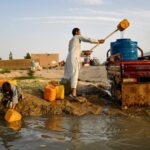
In different regions of Kabul, residents meet their water needs through varied and precarious means: public shared water taps on roadsides, mosques, neighbours’ houses, or private firms at high prices. In Khair Khana, Beni Hesar, and other areas, residents — especially children — wait in long queues to fetch water, sometimes once to four times daily. Children attend water queues instead of school classes. They depart their homes in the morning to fetch only a few barrels of water, which might take until evening. If the queues are long, they may return with nothing.
A few households in each area own borewells, and the rest depend on these households to meet their water demands. Some households on the edges of the mountains bear long hours of waiting in queues. A woman fell while fetching water and broke her leg, unable to walk for nearly 25 days. Some households provide raw water from moving water tankers, mosques, and neighbours’ houses.
(iii) Financial and Agricultural Consequences
The water crisis in Kabul has triggered financial and agricultural crises for households. Financially, water prices have increased, imposed by private water firms over the past half-decade. Some households spend approximately 15 to 30 percent of their income on water provision. In 2008, water shortage already caused quarrels among households. The informal lenders charged households 15 to 20 percent interest per month on loans taken to dig wells, and in some areas, 68 percent of households owed cash for this purpose.
Agriculturally, the shortage of water led to a 40 percent increase in the price of wheat from 2021 onwards, at a time when 80 percent of agriculture is dependent on groundwater. Water depletion in the Qargha dam made 12,000 hectares of land useless and placed approximately 500,000 agricultural jobs in jeopardy. The tap water in affected areas has an unpleasant taste, a bad smell, low pressure, delayed delivery, and insufficient quantity for expanded families, forcing households to spend more on bottled water or water tankers.
(iv) Governance and Institutional Failures
Since the Islamic Emirate took power, international donors have declined their financial support. Senior officials of the Islamic Emirate, including Abdul Ghani Baradar, the deputy prime minister, and Sher Mohammad Abbas Stanekzai, a senior Taliban member, have acknowledged that the water crisis is critical not only in Kabul but across Afghanistan. The Guardian reports that the Islamic Emirate does not prioritise the provision of safe drinking water for Kabulis, allowing private firms to fill the gap at high prices.
The Islamic Emirate has no formal legal water sharing framework with its neighbours. According to the acting Minister of Economy, Din Mohammad Hanif, the Islamic Emirate is planning to prevent billions of cubic metres of water from streaming abroad. At a cabinet meeting on water demands, the leadership team assigned relevant bodies to appropriately manage water distribution across the country.
C. The Future — Projections, Plans, and Prospects
Mercy Corps, in a 2025 report, warned that if the Islamic Emirate fails to implement initiatives effectively, Kabul’s water bodies will be depleted by 2030. Approximately three million people will face relocation — a finding corroborated by UNICEF. According to hydrologists, Kabul is on course to become the first modern city to face severe water scarcity. The Guardian has reported that about 50 percent of Kabul’s borewells are on the brink of water shortage. If current trends continue, the wells now dug to 200 metres will put irreversible pressure on aquifers. The drawdown of Kabul’s water tables, at 3.5 metres per year as acknowledged by the Islamic Emirate itself, shows no sign of reversing without significant intervention.
Based on the United Nations, households are experiencing a continuing decline in daily water allocation. According to Dayne Curry, Mercy Corps’s country director, the Islamic Emirate must maintain close coordination with international donors to secure funds for long-term water initiatives. Without this, the crisis will intensify.
(i) Planned Infrastructure Projects
The Islamic Emirate has responded to the crisis with plans for several major infrastructure projects, though progress has been hampered by budget shortages and the freeze of international capital. Plans were made to transfer water from several dams to Kabul.
The first is the Shahtoot/Lalandar dam, located 30 kilometres from Kabul, with an estimated cost of $236 million. This dam will serve nearly 2 million people and irrigate approximately 4,000 hectares of land. It will be built in the Chahar Asiab district and is tentatively planned for implementation by 2027. The second is the Shah-Wa-Arus (Groom and Bride) dam, located 30 km southwest of Kabul in the Shakardara district, which is now completed. Funded by India, a strategic ally and supporter of Afghanistan, this dam produces 5 million cubic metres of water for nearly 20,000 households. The Islamic Emirate completed it in 2024.
The Panjshir River transfer plan is another long-term initiative: a 200 km pipeline from the Bazarak-e-Panjshir region to Kabul, with an estimated capacity of 100 million cubic metres of water per year and a cost of $170 million, to be transferred to the Tarakhail region. Unfortunately, this project is currently suspended due to budget shortages. Kabul’s governor, Aminullah Obaid, has stated that Kabul’s water crisis will be addressed soon through the transfer of water from the Panjshir River and the Shahtoot/Lalandar dam, a position supported by environmental expert Sayed Mohammad Solaimankhail.
In addition, the Soorubi district, 50 km east of Kabul, contains a water filtration system with an estimated budget of $500,000, funded by UNICEF and enforced by the Ministry of Rural Rehabilitation and Development, supplying 1,290 households with water. The Ministry of Energy and Water has built eight dams in total, some completed and some still incomplete. The Ministry has also requested both national and international donors to implement long-term initiatives for the elimination of the water crisis.
(ii) The Path Forward
International bodies such as the ICRC and UNICEF have also planned interventions to address the water crisis. However, due to budget shortages, executing water projects remains far-fetched without a restoration of international donor support. The Islamic Emirate must work on establishing a sound relationship with foreign donors, as long-term initiatives — particularly the Panjshir River transfer and the Shahtoot dam — are essential to preventing the worst projections from materialising.
Long-term structural changes are also necessary: curbing unmanaged urbanisation, reducing uncontrolled water consumption, addressing climate change impacts on the Hindu Kush snowpack, and establishing a formal legal water sharing framework with neighbouring countries. Without these measures, Kabul risks becoming the first modern capital to run out of water — a distinction that would carry catastrophic consequences for millions of its residents.
Conclusion
The water crisis in Kabul is the product of four decades of conflict, governance failures, rapid and unmanaged population growth, global political pressures, and accelerating climate change. In the past, civil war and neglect degraded infrastructure while international aid failed to produce lasting solutions. Today, Kabulis across regions such as Kart-e-Char, Khair Khana, Beni Hesar, and Dehmazang face contaminated, depleted, and prohibitively expensive water. Kabul stands at an inflexion point: without urgent, coordinated, and adequately funded action by the Islamic Emirate, international donors, and the global community, the city may indeed become the world’s first modern capital to run out of water by 2030.
REFERENCES
Associated Press. (2026, April 14). Afghanistan’s capital is in the grip of a water crisis. WTOP News. https://wtop.com/fashion/2026/04/afghanistans-capital-is-in-the-grip-of-a-water-crisis/
Mercy Corps. (2025, April). Kabul’s water crisis: An Inflection Point for Action. https://www.mercycorps.org/sites/default/files/2025-05/crisis-analysis-team-kabul-water-april-2025.pdf
SouthAsia Newsline (SAN). (2022, July 20). Water shortage threatens Afghanistan’s capital city, Kabul. YouTube. https://www.youtube.com/watch?v=ALxasGfsAM4
The World is One News (WION). (2025, June 8). Severe Water Crisis Looms Over Afghan Capital. YouTube. https://www.youtube.com/watch?v=rz16zy9QDBk
StratNewsGlobal. (2025, July 10). Kabul To Run Out of Water in Five Years. YouTube. https://www.youtube.com/watch?v=NL7Ivb9Uql0
International Committee of the Red Cross. (2026, March 22). Afghanistan: Searching for water is a daily battle for many Afghan families. https://www.icrc.org/en/article/afghanistan-searching-water-daily-battle-many-afghan-families
Reuters. (2025, September 29). Water crisis in Kabul forces families into long queues. YouTube. https://www.youtube.com/watch?v=BF7qZLZnACE
Amini, Mariam. (2025, June 7). Kabul at risk of becoming first modern city to run out of water, report warns. The Guardian. https://www.theguardian.com/world/2025/jun/07/kabul-could-become-first-modern-city-to-run-out-of-water-report-warns
Lindblom, Julia. (2025, July 6). Water increasingly difficult to obtain in Kabul. Göteborgs-Posten. https://www.gp.se/nyheter/varlden/allt-svarare-att-fa-tag-pa-vatten-i-kabul.30b1d90b-f1ac-475e-b50b-f26dda0536ff
UNICEF. Water, sanitation and hygiene. https://www.unicef.org/afghanistan/water-sanitation-and-hygiene
Asiaonenews. (2025, October 5). Kabul’s Growing Water Crisis Forces Children to Skip School. YouTube. https://www.youtube.com/watch?v=Jrp-Hd_2hE0
Gomo, Tapiwa. (2023, August 1). Afghanistan: The alarming effects of climate change. UNOCHA. https://www.unocha.org/news/afghanistan-alarming-effects-climate-change
BBC Monitoring. (2025, August 5). Explainer: How serious is the water crisis in the Afghan capital? https://monitoring.bbc.co.uk/product/b0004bwh
TRT World. (2026, April 19). Kabul residents struggle as groundwater runs dry. YouTube. https://www.youtube.com/watch?v=yVqk7eZJTPM
Our Daily News Online. (2024, November 22). Kabul Faces Severe Water Crisis: UN Warns of Groundwater Depletion. YouTube. https://www.youtube.com/watch?v=cyFfzoBxywo
Hasht-e Subh. (2025, May 18). Kabul’s Water Crisis: Residents Alarmed by Depleting and Contaminated Supplies. Afghanistan Analysts Network. https://www.afghanistan-analysts.org/en/recommended-reading/kabuls-water-crisis-residents-alarmed-by-depleting-and-contaminated-supplies/
Global Dispatches. (2025, November 20). Live From Kabul — The World’s First Capital Facing Total Water Collapse. YouTube. https://www.youtube.com/watch?v=k1YawKiryFE&t=15s
Mirror Now. (2025, September 29). Afghanistan Water Crisis: Families in Kabul Forced to Wait in Long Queues. YouTube. https://www.youtube.com/watch?v=P9wfNzWYuq4
Najibullah, Farangis. (2025, July 6). Kabul On Course to Be World’s First Capital to Run Out of Water. RadioFreeEurope Radio Liberty. https://www.rferl.org/a/kabul-water-crisis-running-out-of-water-afghanistan-2025/33461892.html
(Qudratullah Yousofi is a Kabul-based English instructor. He has worked as an English interpreter & translator, a peace ambassador, and a researcher. This Special Report has been published as part of the ongoing ‘Fragility, Conflict and Peace Building’ project of Mantraya. Opinions expressed in this Special Report are the author’s. All MISS publications are peer-reviewed.)