MANTRAYA ANALYSIS #98: 27 MAY 2026
BIBHU PRASAD ROUTRAY
Abstract
Indonesia has had no terrorist attacks for three consecutive years, which speaks to the operational degradation of Islamist groups such as Jamaah Ansharut Daulah. However, a more insidious threat has emerged: the online radicalisation of children and teenagers through Neo-Nazi and far-right extremist ideologies, manifesting in school attacks in Jakarta and West Kalimantan. Indonesia now faces the challenge of adapting its counter-terrorism and deradicalisation frameworks to this emerging threat.
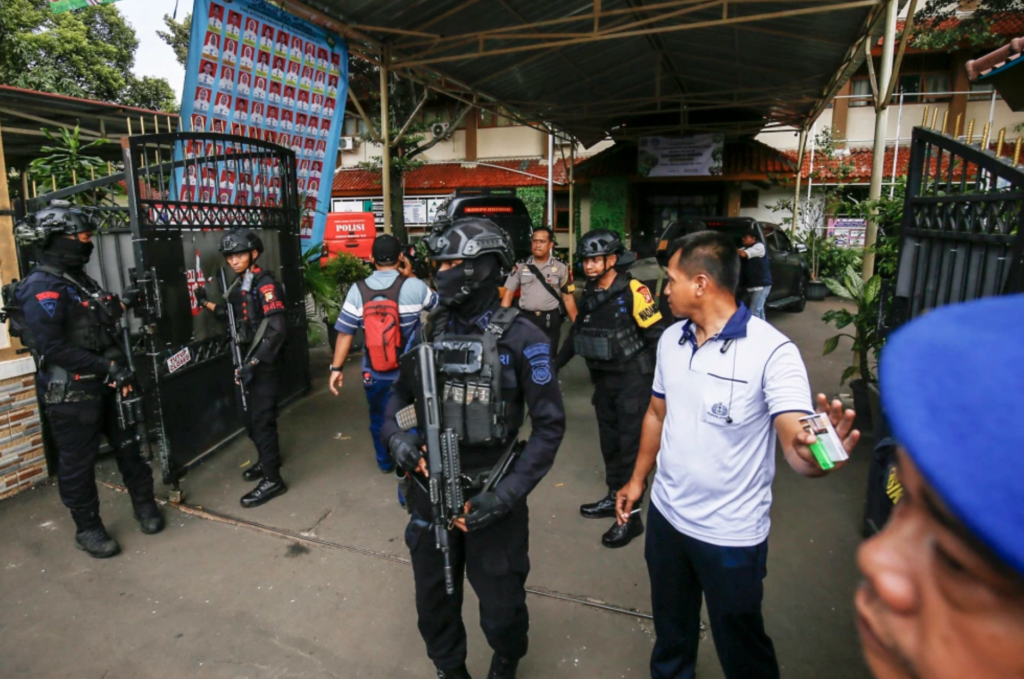
(Bomb squad officers stand guard at the entrance of a school in Jakarta following explosions on 7 November 2025. Image Courtesy: NBC News.)
JAD’s Degradation
In early May, Indonesia’s National Police, Densus 88, arrested eight suspected terrorists linked to the Jamaah Ansharut Daulah (JAD) network in Central Sulawesi’s Poso and Parigi Moutong districts. The JAD, which was designated as a ‘forbidden organisation’ by an Indonesian court in July 2018 after a series of suicide bombings at churches in Surabaya, is affiliated with the Islamic State. The arrested persons, according to the police, had allegedly spread extremist propaganda through social media posts and videos.
Arrest of terrorist suspects isn’t uncommon in Indonesia. Indonesia has had no terrorist attacks for three consecutive years (2023-2025), a result due at least in part to the arrest of 253 suspects in those years. In 2023, 147 suspects were arrested; in 2024, 55; and in 2025, 51. The JAD carried out its last major attack using a suicide bomber in December 2022. The attacker, armed with a knife, detonated a device at a police station in West Java, killing himself and a police officer. Eleven others were injured.
Nonetheless, even with this absence of major terrorist violence, Indonesia has been ranked 24th in the Global Terrorism Index 2026. While the epicentre of terrorism has shifted to Africa’s Sahel region, where local outfits affiliated with al Qaeda or the Islamic State wreak havoc, Indonesia still records incidents, making it a country with a steady challenge posed by terrorism.
Complex Threats and Domino Effect
While the latest arrests in May 2026 point to the terrorism inspired by global jihadist organisations, Indonesia’s woes have become far more complex. Its counter-terror organisation’s ability to stop group-based terrorism has improved, resulting in the operational degradation of violent organisational projects, yet individuals continue to pose a danger. Threats continue from individuals affiliated with JAD networks, the lone-wolves or the self-radicalised, and also, as one incident in late 2025 demonstrated, the domino effects of terrorism elsewhere.
In the latter instance, in November 2025, four explosive devices were detonated inside a school premises in the capital Jakarta during Friday prayers, injuring over 90 students, some with burns and others with injuries from flying shrapnel and shattered glass. There were no reported deaths. Investigations led to the arrest of a 17-year-old student of an adjacent school who also had suffered injuries and reportedly underwent surgery. Of the seven crude explosive devices he had prepared at home, three had failed to detonate, reducing the scale and impact of the attack.
This attack was novel in many ways, particularly involving such a young individual. While the perpetrator had learnt the crude bomb-making techniques on the dark web, the reasons for his motivation were attacks previously carried out by white supremacist figures and neo-Nazi groups in faraway countries. From the house of his parents, police recovered two toy guns covered in scrawled handwriting, which featured the names of perpetrators of shootings such as Brenton Harrison Tarrant, the Christchurch mosque attacker who killed 51 people in New Zealand in 2019, and Anton Lund Pettersson, who stabbed a teacher and student to death at a school in Sweden in 2015.
The Indonesian student, police investigations found, had been subjected to bullying and loneliness, and was acting to deal with this personal crisis by learning from similar incidents in other countries. For instance, there are also indications that he might have been inspired by other school shootings, such as the Columbine High School massacre, in which 13 students and one teacher were killed in 1999 by two high school students. For the record, Columbine has inspired over 80 copycat attacks.
While the Indonesian investigators treated this incident as a ‘non-terrorism’ incident, it pointed to the possible spread of online far-right and white supremacist ideology, not linked to any specific group, among male youths of the Southeast Asian region. The arrest of an 18-year-old student, Nick Lee Xing Qiu (Lee), in neighbouring Singapore in December 2024 was similar. Lee was radicalised by violent far-right extremist ideologies and aspired to conduct attacks against Malays and Muslims in Singapore, following the examples of Brenton Harrison Tarrant.
In January 2026, the Indonesian police reported a possible connection between the Jakarta school explosions and a school stabbing in Moscow on 16 December 2025. Armed with a knife, a 15-year-old student, identified as Mario Nawfal, had killed a fourth-grade student and injured a security guard in a school in the Gorki-2 settlement of the Odintsovo District, Moscow Region. The handle of the knife used in the attack was inscribed with the words ‘2025, Jakarta Bombing.’
Yet another attack
On 3 February 2026, a ninth-grade Junior High School student in West Kalimantan threw a Molotov cocktail on school grounds, injuring another student. Six more bottles containing fuel oil and cloth wicks (Molotov cocktails) were found in his backpack with various symbols and names of previous attackers from various countries, including the 2019 Sri Lanka Easter bombings mastermind Zahran Hashim, as well as Stephen Paddock, the perpetrator of the 2017 Las Vegas mass shooting. He was connected with the “True Crime Community” Neo-Nazi Terrorgram circle, like the previous Jakarta school bomber. While his behaviour was normal at school, police believed that the student was possibly a victim of bullying and wanted revenge against his peers who frequently targeted him. Furthermore, the child was also strongly suspected of facing family problems.
Increasing Scale of Radicalisation
It seems that while the November 2025 Jakarta school bombing and the February 2025 West Kalimantan incident were the overt manifestations of simmering radicalisation, a large number of interceptions threw light on the intensity of the problem facing the country.
Investigation into the Jakarta school bomber’s internet circles revealed his connections with 68 children and teenagers from 18 provinces through a Telegram community named the ‘True Crime Community.’ They had discussed white supremacism and Neo-Nazi ideologies. These children were not only indoctrinated online but also possessed dangerous weapons and planned attacks targeting their schools and peers.
In December 2025, Densus 88 said that they had foiled 20 planned school attacks after the Jakarta school bombing. The revelations came after a teenager, described as ‘gifted and a genius’ by locals, was arrested in Garut in West Java for harbouring far-right extremist ideologies and spreading bomb-making, weapon-making, and bullet-making materials in a WhatsApp-based group on 23 December 2025. Police also uncovered five individuals who had formed a Neo-Nazi network, intending to recruit and indoctrinate 110 children and teenagers from 23 provinces. One route of indoctrination was through violent online games.
Further, on 7 January 2026, Densus 88 announced that 70 children and teenagers from 19 provinces, including 27 from Jakarta and West Java, were discovered to have connections to Neo-Nazi and far-right extremist ideologies through 27 Indonesian Neo-Nazi Terrorgram circles. The majority of them were 7th to 9th graders, with their ages ranging from 11 to 18. Their youth notwithstanding, all were found to be capable of creating makeshift weaponry and pipe bombs and were also capable of arming themselves for sudden attacks. Some had already created plans for attacks on schools, involving methods such as mapping and disabling CCTV systems, planting bombs in classrooms, and learning how to kill their own classmates and teachers.
Measured Response
So far, Indonesia’s National Counter Terrorism Agency (BNPT) has been reluctant to classify the Jakarta and West Kalimantan attacks as terrorism, citing the fact that the assaults lacked the organisation and features typically associated with Islamist terrorism. Instead, BNPT attributes the violence to the influence of violent online games, which they believe instil a sense of revenge and aggression in impressionable children. Unlike Islamist terrorism, which has prompted the implementation of strict measures, the school children involved in these incidents have been assessed, mapped, and referred for counselling as a preventive measure. This approach appears to be an extension of Indonesia’s de-radicalisation program, which remains a strategy despite the rising rates of recidivism.
Between 2002 and 2020, at least 94 terrorist ex-convicts returned to terrorism, accounting for 11.39 percent of terrorist inmates released in that period. In comparison, in Europe, the recidivism rate stands at between 2 and 7 percent. And yet, Indonesia hasn’t given up on its ‘soft approach,’ which keeps the pathway to return to mainstream society open for the genuinely deradicalised. With the JAD operationally degraded, the country believes that it has more than adequate elbow room to keep experimenting, even with the Islamic State reemerging as a major source of terror in the Sahel.
When it comes to children and juveniles exposed to Neo-Nazi and far-right extremist ideologies, adopting a gentle approach makes sense, as it helps prevent them from becoming hardened terrorists. However, the growing scale of online radicalisation suggests that counselling and deradicalisation alone may struggle to keep up with the rapid pace and wide reach of digital indoctrination.
Hence, Indonesia’s main challenge may not only involve neutralising existing threats but also building societal resilience. This can be achieved through stronger family support systems, improved mental health frameworks, and enhanced digital literacy aimed at preventing the next generation from falling into cycles of violence before they even begin. Accomplishing this is no easy task for a country of over 287 million people living across thousands of islands. However, counter-terrorism has never been less than a daunting endeavour.
( Dr. Bibhu Prasad Routray is the Director of MISS. This analysis has been published as part of Mantraya’s ongoing “Mapping Terror & Insurgent Networks” and “Fragility, Conflict, and Peace Building” projects. All Mantraya publications are peer-reviewed.)