MANTRAYA ANALYSIS #99: 19 JUNE 2026
BIBHU PRASAD ROUTRAY & SHANTHIE MARIET D’SOUZA
Abstract
For years, the truth behind the coordinated suicide attacks on Easter Sunday in 2019 in Sri Lanka remained obscured by political interference and systemic obstructions within the state apparatus. However, the current left-wing National People’s Power (NPP) administration has catalysed a dramatic shift in accountability. By accusing the country’s former intelligence chief of a direct role in orchestrating the attacks, it has sought to bring focus on the possible role that the intelligence agencies may have played in the attack. No matter how the investigation proceeds, the government would need to establish independent parliamentary oversight over intelligence operations and the statutory depoliticisation of state investigative bodies.
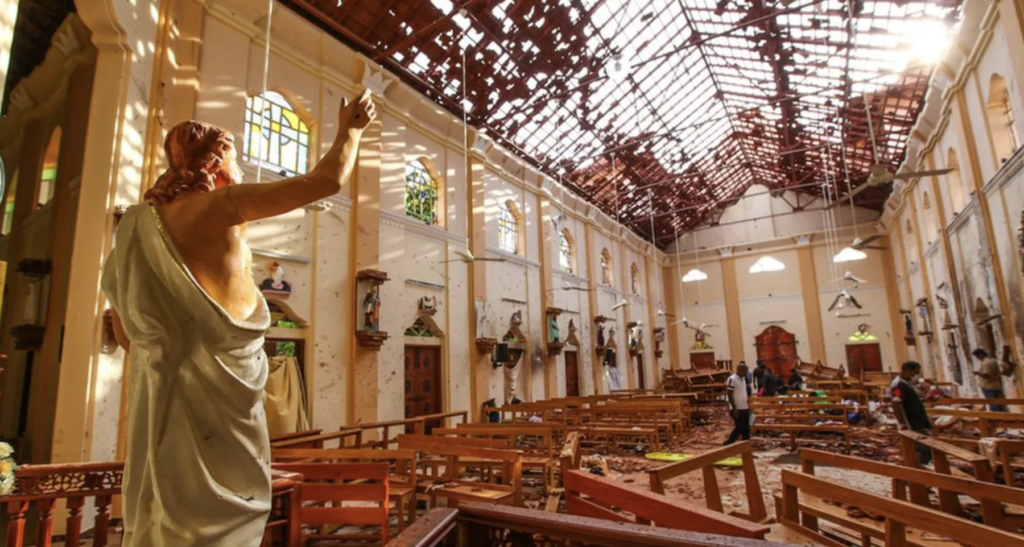
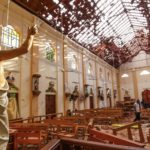
(A statue amid debris at St Sebastian’s Church in Negombo, Sri Lanka, following the Easter Sunday bombing.
Description and Image courtesy: BBC)
Introduction: Reigniting the Debate
On 10 June, Sri Lanka’s Public Security Minister Ananda Wijepala reopened the debate over the Easter Sunday bombings in the country that killed 279 people on 21 April 2019. Speaking in parliament, he said that the country’s former intelligence chief Major General Suresh Sallay directed the attack. Sallay, a decorated military officer, has been under arrest under the Prevention of Terrorism Act (PTA) since February 2026. A Sri Lankan court has also imposed an overseas travel ban on former President Gotabaya Rajapaksa over the probe. Will Wijepala’s statement, the first official statement that links Sallay to the attack, shed new light on the attack or is merely a part of the divisive politics between the right-wing Sinhala nationalists and the left-leaning current NPP government in the island nation remains to be seen.
The ‘Worst’ Attacks: An Intelligence Failure?
The attack, described as the worst single terror attack against civilians, involved bombings by six suicide bombers against three upmarket hotels in the capital, two Roman Catholic churches, and an evangelical Protestant church outside Colombo. Along with Sri Lankans of different faiths, 45 foreign nationals, including 11 Indians, eight British, six Chinese, and five Americans, perished in the attack.
In the investigations that followed, an obscure National Thowheeth Jama’ath (NTJ) group, aligned with the Islamic State (IS), was found responsible for the attack. The IS chief Abu Bakr Baghdadi, who was killed a few months later, praised the attack, saying the bombings were a revenge for the fall of Baghouz, Syria, the last territory the extremist group held there or in Iraq. Investigations by Sri Lankan agencies as well as by the Federal Bureau of Investigation (FBI), while blaming the NTJ, also revealed that the government of the day had faltered by not acting on inputs provided by Indian and American agencies in early April 2019. One memo compiled by Sri Lankan security officials was so specific that it even gave a list of suspects, their names, addresses, and phone numbers.
Then President Maithripala Sirisena, who was vacationing in Singapore during the bombings, later accepted the charges and apologised for the lapses. It all appeared to be an open and shut case of locally executed bombings inspired by a global jihadist organisation. Also, it was a story that unfolded rapidly, much like a deck of cards cascading to the ground. Too simple to be the whole truth.
The fact remained that the subsequent investigations by Sri Lanka’s Criminal Investigation Department (CID), the State Intelligence Service (SIS), and a dedicated Presidential Commission of Inquiry (PCoI) appointed shortly after the bombings, failed to provide any answers for how the attacks took place and the exact nature of security lapses that led up to them. The fact that all the suicide bombers had died during the attack was presented as a closure to the conspiracy. While more than 200 people were charged in the investigation, there have been no criminal convictions in the case to date. There have been no answers on how several specific high-level warnings about the imminent attacks, particularly from Indian intelligence, were ignored.
Nevertheless, President Sirisena’s government’s failure to prevent the attacks became a huge plank for the right-wing nationalists in the Presidential elections held in November 2019. Gotabaya Rajapaksa, a former wartime defence chief and brother of the former President Mahinda Rajapaksa, declared his candidacy two days after the bombings. He campaigned on a strong security platform promising to stamp out Islamist terrorism from the country and secured a clear victory with 52.25 per cent of the vote. Subsequently, he capitalised on the presidential momentum and, in the Parliamentary elections held in August 2020, the Rajapaksa-led coalition (Sri Lanka Podujana Peramuna, SLPP) won a landslide victory, securing a two-thirds majority in the 225-member parliament.
This marked the return of the Rajapaksa family to power, after former President Mahinda Rajapaksa was ousted in 2015 after a backlash against alleged corruption. While the electoral victories allowed them to consolidate immense political power to reshape the security set-up, part of the Sri Lankan society, including the Catholic Church, remained unconvinced about the conspiracies behind the attack.
Search for the ‘Mahamolakaru’: The Missing Link
Minister Ananda Wijepala’s 10 June statement blaming Suresh Sallay is a part of the left-wing National People’s Power (NPP) government’s electoral promise, during the 2024 Presidential and Parliamentary elections, to find the ‘mahamolakaru’ (mastermind) behind the attacks. It is by no means a novel revelation, although it is the first instance when an official statement linked former intelligence officials to the attack. At present, Sallay has been presented as the leader of the pack, who can unravel the mystery behind the attacks.
Accusations against Sallay, who was also the head of the military intelligence credited with playing a role in dismantling the Liberation Tigers of Tamil Eelam (LTTE), are serious. He has been accused of leading the deep state that conspired to bring the right-wing nationalist Gotabaya Rajapaksa to power and succeeded. More specifically, he has also been blamed for ‘aiding and abetting’ the attack by not just planning the entire plot, but also by directing the attack and even identifying a Catholic church to be bombed.
Just three weeks before the attack, Sallay allegedly ‘met Muslim men to obtain details of the location and the congregation’, Minister Wijepala has said. The fact that Sallay was appointed as the head of the SIS, the country’s main spy agency, soon after Gotabaya Rajapaksa became president in 2019, is being cited as a case of reward for the services he rendered to ensure the electoral results.
The Deep State: Media Expose
Much of the NPP’s objective to find the real mastermind runs close to the exposé by the British broadcaster Channel 4’s investigation in 2023, primarily based on a whistleblower’s account. The documentary titled ‘Sri Lanka’s Easter bombings’, which was aired on 5 September 2023, relied on the information provided by Mohammed Milhilar Mohammed Hanzeer alias Azad Maulana —a long-time, high-level insider and spokesperson for the Tamil Makkal Viduthalai Pulikal (TMVP) politician Sivanesathurai Santhirakanthan (a.k.a. Pillayan), a key ally of the Rajapaksa family. Maulana claimed to have brokered a crucial meeting in 2018 between Sallay and NTJ members, including the chief perpetrator Zahran Hashim. The plan, according to him, was to create an ‘unsafe’ security situation that would help bring Rajapaksa to power.
Because Maulana was entrenched within these political circles, international analysts have treated his testimony with the seriousness it deserves, despite some of its lacunae like Sallay’s absence from Sri Lanka on the day of the ‘meeting’ with NTJ members. Maulana fled Sri Lanka in 2021 via India and is currently based in Switzerland, pleading for asylum. He has declared that he is willing to testify only before an international forum, and not in Sri Lanka, where there is danger to his life.
The exposé was dismissed by Gotabaya as being an ‘anti-Rajapaksa tirade’ and part of the channel’s long history of adversarial reporting on Sri Lanka. In July 2022, he had been forced to resign during mass protests over an economic crisis. In his statement, after the documentary was released, he denied having any contact with Sallay from the time he resigned as defence secretary in 2015 until he became president in 2019. He also said that Sallay was not part of any intelligence agency during that period and allegations that he met the suicide bombers were a fabrication. Sallay served as a military advisor at the Sri Lankan High Commission in Malaysia between 2016 and 2018. Before becoming SIS chief, he was a student officer with the National Defence College in New Delhi, between January and November 2019.
Sri Lankan right-leaning nationalist groups still point to Channel 4’s controversial 2011 film ‘Sri Lanka’s Killing Fields’ to argue that the network has an institutional bias against the country’s military and conservative leadership. It’s a different matter that the film’s corroboration of systemic and extra-judicial killings, rape, and torture of LTTE cadres, sympathisers, and Tamil civilians perpetrated by the Sri Lankan security forces is supported by facts and visuals.
Lending credence to Maulana’s narration are the head of Sri Lanka’s Catholic Church, Cardinal Malcolm Ranjith, and survivor advocacy groups who have long insisted that a shadowy ‘Deep State’, under President Rajapaksa, orchestrated a massive cover-up of the attack. And their charges aren’t without substance.
A year before the Channel 4’s documentary was aired, Shani Abeysekara, the former head of Sri Lanka’s CID, who was overseeing the investigation, had gone public with allegations that before the attacks – when the CID was already investigating NTJ militants – state and military intelligence officers had sabotaged the investigation and “fabricated” evidence to divert investigators away from the group, including ringleader Zahran Hashim. Rajapaksa removed Abeysekara and demoted him. In 2020, he was arrested and remanded on allegations of fabricating evidence in a past murder trial. He was later released on bail in June 2021. The Administrative Appeals Tribunal ordered his promotion after determining he was subjected to political victimisation. In December 2023, the attorney general informed the courts that there also had been a conspiracy to murder Abeysekara.
According to former director general of police Ravi Seneviratne, Gotabaya as President ‘prevented the investigation’. While his team had established links between state and military intelligence officers and the NTJ suicide bombers, after Rajapaksa took office, the entire team at CID was taken off the case. More than 20 of his officers were transferred without his approval and travel bans were imposed on all 700 CID officers. Many of the scared officials applied for transfers out of CID, according to Seneviratne.
Investigations into the bombings, thereafter, focused on finding loopholes with the acts of omission and commission by the government of the day and called for former President Sirisena as well as senior police and intelligence officials to be prosecuted.
Need for a Closure: Restoring Public Trust
It is still possible that the NPP government is merely propounding a counternarrative. The Sri Lankan opposition leaders have already launched protests in support of Sallay, who, through his lawyer, has denied any involvement in the attacks. While the CID, incidentally now being headed by Shani Abeysekara, stopped short of naming Gotabaya Rajapaksa as a suspect, following Sallay’s interrogation, investigators have secured court orders preventing him from leaving the island.
No matter how the investigation proceeds, the unresolved case has become a mirror reflecting Sri Lanka’s deeper political pathology, where institutions meant to deliver justice are repeatedly weaponised to settle scores rather than establish facts. Each successive government, regardless of ideological orientation, has shown a pattern of selectively activating or shelving investigations to suit its political convenience. The NPP’s current push, however well-intentioned, risks following the same script unless it is backed by transparent, time-bound judicial processes rather than parliamentary statements designed for political effect.
What is at stake extends beyond identifying individual culprits. The families of 279 victims, the survivors who still bear physical and psychological scars, and a Catholic community that has waited years for accountability deserve more than another chapter in a saga of political point-scoring. For Sri Lanka’s fragile democratic institutions, a credible and impartial conclusion to this investigation could help restore some measure of public trust in a state apparatus widely seen as complicit in its own citizens’ suffering.
(Dr. Bibhu Prasad Routray is the Director of MISS. Dr. Shanthie Mariet D’Souza is the Founder & Executive Director of MISS. This analysis has been published as part of Mantraya’s ongoing “Mapping Terror & Insurgent Networks” and “Fragility, Conflict, and Peace Building” projects. All MISS publications are peer-reviewed.)