MANTRAYA ANALYSIS #101: 23 JULY 2026
BIBHU PRASAD ROUTRAY
Abstract
Nearly 530 Rohingya refugees are feared drowned off Myanmar’s coast this July, part of a mounting toll from desperate sea crossings toward Malaysia. These perilous journeys are the result of widespread desperation amid shrinking humanitarian funding, drastically cut global resettlement quotas, and a homeland in Rakhine State now controlled by the Arakan Army, an armed group with its own hostile history toward the Rohingya. With repatriation effectively foreclosed and legal pathways abroad narrowing, Bangladesh will likely remain host indefinitely to over a million refugees. Without urgent investment in education, livelihoods, and regional cooperation, this unresolved crisis risks fueling radicalisation and instability, spilling over well beyond Cox’s Bazar.
The Drowning and The Burials
On 16 July, the International Organisation for Migration (IOM) of the United Nations and the refugee agency, UNHCR, reported the high possibility of nearly 530 people drowning to death off the coast of Myanmar while travelling out of the country in two boats that sailed in June. Most of the feared dead are Rohingya from the Rakhine state of Myanmar and also some belonging to the camps in Bangladesh, where nearly 1.2 million live in sub-human conditions. The boats were most likely travelling to Malaysia, which remains the preferred destination for the Rohingya in search of better lives, despite the growing anti-Rohingya hostility in that country. Another 300 Rohingya are estimated to have died in similar circumstances previously this year.
Also, in separate incidents in the first week of July, over 15 Rohingya men, women, and children were killed in landslides in the camps amidst heavy monsoon rains in Cox’s Bazar in Bangladesh, which houses over 1.2 million refugees. In one instance, piles of mud and debris buried a makeshift madrassa and five of its students. This is not an isolated tragedy. According to the UNHCR, 36 refugees had died in similar landslides between 2021 and 2026. The refugee agency plans to shift about 1,000 refugees out of vulnerable locations, but the alternate spots, barring their probable immunity from landslides, offer no real escape. They are simply a different shade of confinement, trading one danger for continued deprivation.
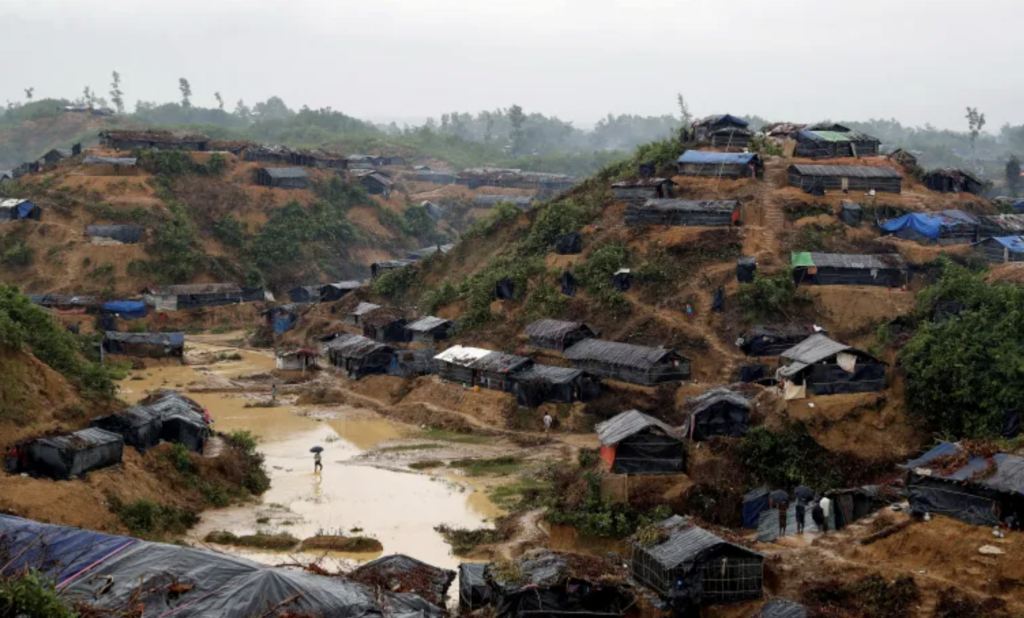
(A Rohingya refugee camp in Cox’s Bazar, Bangladesh. Photo Credit: Al Jazeera)
Death: An Escape?
These continuing deaths can, at one level, be framed as an escape from the agonising misery inflicted upon the Rohingya, which started with the Myanmar military’s ‘textbook example of ethnic cleansing’ that caused it in the first place.[1] Concepts such as Durkheim’s ‘fatalistic suicide ’ indicate intense, rigid social control crushing the individual’s agency and blocking all prospects, thereby making death appear as the only route to relief. Still, this incorrectly places the responsibility on the choice or lack thereof of the refugees. Instead, these deaths are symptoms of systemic violence, rather than a personal failure or a voluntary exit from life.
While Bangladesh state’s chronic lack of capacity and will to provide for such a large mass of people has accentuated such desperation over the past years, the fast vanishing of humanitarian funds, caused primarily by the callous policies of the US President Donald Trump administration, has made life with dignity and hope for the future in the camps an impossible project for the refugees.
Escape to another country by undertaking perilous sea journeys on rickety boats, therefore, becomes a dire necessity, even when accompanied by a high probability of death. Before Trump assumed office in early 2025, most refugees in the camps received food assistance of some $12 per month. This meagre amount has been reduced to only $7 per month and is available to just one-third of the people. The World Food Programme (WFP), while desperately asking for restoration of funds, has indicated that absent restoration, providing for the growing refugee population would come under more strain. The UNHCR itself has called for a ‘paradigm shift’ that ‘creates a new sense of hope and opportunity for people fleeing war and persecution’.
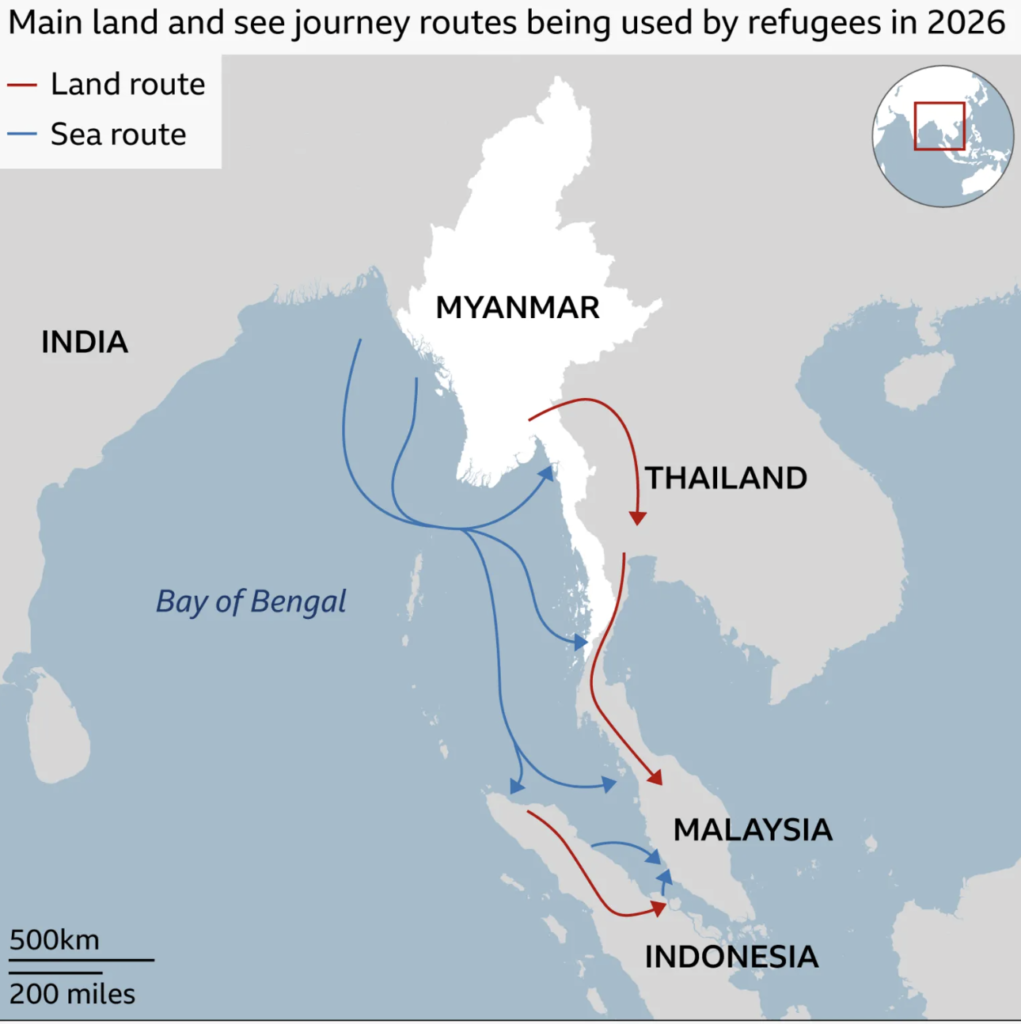
(Land and sea journey routes taken by Rohingya refugees since 2026, Photo Credit: UNHCR/BBC)
The perilous and desperate journeys also need to be viewed in the context of a gradual decline in global refugee resettlement quotas. The current raging wars and hunger in the world are adding substantially to the number of people seeking legal resettlement. In theatres such as Sudan, DRC, and Gaza, there has been a drastic increase in the refugee population. In Sudan, by early 2026, the numbers nearly doubled to 2.8 million, and DRC refugees exceeded 1.17 million, doubling over the last decade. These pose competing claims on the same limited resettlement pot. The UNHCR says that while 2.4 million refugees will require resettlement in 2027, destination countries have slashed their quotas, resulting in a 75 percent drop[2] in European Union commitments and severe cuts in the United States. As a result, the gap between available spots and the number of people in need is growing wider worldwide, and the desperate cry of the Rohingya, from a remote corner of the world, appears to have been all but forgotten.
Return to Myanmar?
The ideal solution to the Rohingya crisis is their repatriation to their homeland in the Rakhine state, though that is the most improbable one. Much has been written about the reluctance of Myanmar’s military regime to ensure a safe and secure environment for Rohingya willing to return from the camps in Bangladesh. Without security, not a single Rohingya is willing to go back. Additionally, in the past years, the ground situation in Rakhine has changed dramatically, making the state even more dangerous to any Rohingya. Not surprisingly, new Rohingya refugees continue to trickle into Bangladesh. Since 2023, 150,000 new arrivals have been reported.
In late 2023, the Arakan Army (AA), the primarily Buddhist ethnic armed organisation, drove Myanmar’s military out of the region and since then has seized control of the entire Bangladesh-Myanmar border. By May 2024, it had laid siege to Buthidaung township, and by December 2024, it had declared control over Maungdaw. Both townships were once predominantly Rohingya-inhabited. The animosity between the Buddhist AA and the Muslim Rohingya took a worse turn after the Myanmar military started forcibly conscripting the Rohingya to fill its fast-thinning armed forces ranks. The military has even forced the conscripts to burn down Buddhist homes with a bid to incite communal divide between the two and has largely been successful in this project. The AA, which too recruited some Rohingya, has turned completely against the community after the Arakan Rohingya Salvation Army (ARSA), a Rohingya insurgent group, started aligning itself with the military against the AA.
Therefore, for all practical purposes, the very territory Rohingya refugees would need to return to is now controlled by a group with an ambivalent, and at most times hostile, track record toward them. The repatriation, therefore, is no longer a stalled bureaucratic process linked to the attitude of the Myanmar junta government. It is rather a question of returning people to a war zone run by their alleged persecutors.
Prognosis
Thus, for the foreseeable future, Bangladesh is likely to remain the home for the Rohingya refugees. New arrivals and the average birth of roughly 30,000 children per year will continue to increase their number, notwithstanding the few thousand who will undertake the deadly sea journeys. Such a mass of population needs much more than what they receive at the moment in the form of limited employment opportunities and educational rights. With the shrinking humanitarian funds, part of which were being shared with the host communities, the probability of host community and refugee conflict will rise. Much more than that, the desolate, desperate, uneducated, and unemployed Rohingya youth will constitute a large pool to be exploited by not just Rohingya groups such as the ARSA and RSO but also by transnational Jihadist organisations. India, whose relations with Dhaka have dipped in recent years and which treats the Rohingya as determined by a security-first, low-compassion framework, needs to be extra careful.
Left unaddressed, this crisis will not remain contained in Cox’s Bazar. A radicalised or destitute refugee population has a way of spilling across borders and into regional security calculations, whether through militancy, trafficking networks, or renewed waves of displacement. The choice facing Bangladesh and its neighbours is not really whether to keep hosting the Rohingya and limiting their stay in Cox’s Bazar till Myanmar accepts them back, but whether to invest in them now or prepare to manage the later consequences of not having done so.
ENDNOTES
[1] That year, the military spearheaded the killing of an estimated 10,000 Rohingya, sending over 700,000 fleeing into neighbouring Bangladesh. The ethic Buddhist Rakhine also participated in the purge of the Rohingya.
[2] The UNHCR has reported a sharp drop in resettlement, with arrivals through resettlement or sponsorship pathways falling by more than half, year on year, to just 81,800 in 2025. More than 70 per cent of refugees originated from Afghanistan, South Sudan, Sudan, Syria, Ukraine, and Venezuela. The largest host countries were Colombia, Germany, and Türkiye. See United Nations, “Refugee numbers drop for first time in a decade, but millions remain trapped”, 10 June 2026, https://news.un.org/en/story/2026/06/1167693.
(Dr. Bibhu Prasad Routray is the Director of MISS. This analysis has been published as part of Mantraya’s ongoing “Mapping Terror & Insurgent Networks” and “Fragility, Conflict, and Peace Building” projects. All MISS publications are peer-reviewed.)