MANTRAYA ANALYSIS #100: 07 JULY 2026
BIBHU PRASAD ROUTRAY
Abstract
With a resurgent Naga-Kuki conflict adding new fault lines since February 2026, Manipur’s ethnic conflict has deepened beyond the Meitei-Kuki violence that started in May 2023. The killing of six Naga captives has reignited hostilities between the two communities, hardening territorial divisions and disrupting supplies to Kuki areas. Despite stability operations, deepening polarisation fosters the growth of armed groups, underscoring the urgent need for impartial leadership and sustained dialogue to prevent further escalation.
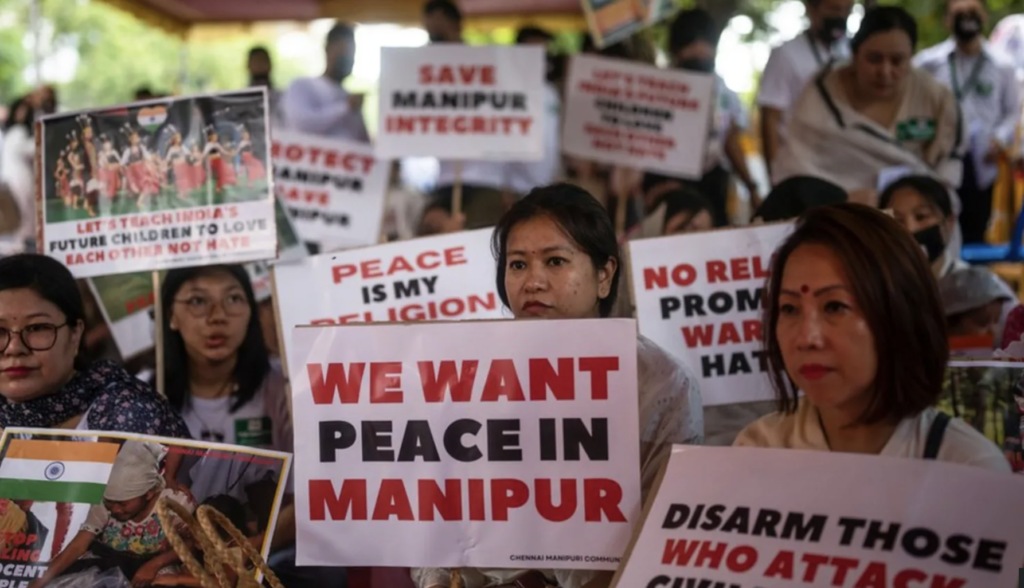
(Women hold a sit-in protest against spiralling violence in Manipur, Image Courtesy: BBC)
Introduction
On 6 July 2026, two Assam Rifles (AR) personnel were killed in an ambush by unknown militants in Manipur’s Ukhrul district. The last time AR personnel had been killed in the state was 10 months earlier, in September 2025. Incidentally, only a month earlier, on 4 June, India’s Home Minister had declared, ‘Insurgency in India’s northeast is no longer an issue.’ The (state) governments of the region should now shift their focus from law and order to protecting the rights of the citizens, he advised. While the Minister was on target regarding the orientation required in most states of the region, Manipur and its surrounding areas remain active conflict zones, presenting a complex mixture of law-and-order issues, ethnic contestations, and insurgency. As days and months pass, new layers are being added to the polarisation between the communities, hardening it and pushing it towards a dangerous state of spiralling conflict, which is bound to be exploited by the insurgents and their external sponsors.
A New Low
Since the onset of the ethnic conflict between the Meiteis and the Kukis on 3 May 2023, the violence has resulted in at least 260 deaths and the displacement of 62,000 people. Recent incidents underscore that there has been little improvement in the acrimonious relationships between the communities.
A new low was reached in Manipur on 17 June, when authorities had to move three injured Kuki youths from the Regional Institute of Medical Sciences (RIMS) hospital in the capital, Imphal, of World War II fame, under heavy security. The injured young men, including a 16-year-old footballer, had been admitted to the hospital after suffering gunshot wounds in an attack two days earlier, allegedly carried out by the cadres of the National Socialist Council of Nagalim (NSCN) and the Kamson faction of the Zeliangrong United Front (ZUF).
As news of their presence at the hospital spread, a large mob of Meitei men gathered outside the hospital gate, throwing stones at security personnel and attempting to storm the facility to take the injured away. In response, the security forces used batons and tear gas to disperse the crowd. The injured men are now being treated at a district hospital in Churachandpur, a Kuki-dominated area.
The Imphal valley and the surrounding areas are inhabited principally by the Meiteis. Kuki organisations said the three youths should not have been admitted to RIMS in the first place, given the ethnic tension.
The Conflict Expands
Since 7 February this year, a new layer has been added to the conflict situation in the state: the resurgence of the Naga-Kuki conflict in the hills. Both communities have a history of prolonged conflict, dating back to the 1990s. This time, the conflict that started in Ukhrul has gradually expanded to Kangpokpi, Kamjong, and Noney districts, some of which are cohabited by Naga and Kuki tribals. So far, 25 people have been killed. But the ‘low’ fatalities hardly summarise the intensity of the hatred and distrust that drives the violence between the two communities.
It started with a minor confrontation between a Tangkhul Naga private teacher and some Kuki youths in the Litan area of Ukhrul district on 7 February. Soon, it flared up and expanded to other districts such as Kamjong and Kangpokpi. The Nagas accused the Kukis of extortion, alleged that some among them were linked to insurgent outfits and reportedly told them to vacate Ukhrul. The Kukis, in turn, made similar accusations against the Nagas, further escalating tensions. Forty houses of both communities were vandalised and torched between 8 and 10 February.
On 13 May, three church leaders belonging to the Thadou (Kuki) tribe were ambushed and killed by suspected Naga armed groups. This led both the Kuki and Naga groups to abduct at least 44 civilians in Kangpokpi and Senapati districts. While 24 of them were released, 14 Kukis and six Nagas remained in captivity. On 9 June, after the intervention of church bodies and other civil society groups, they were released by the United Naga Council (UNC), the apex body of the Nagas in Manipur.
The incident, which also saw intense mediation efforts by the chief ministers of Nagaland and Meghalaya, who referred to ‘Christian values of forgiveness’, was hailed as a positive development. A local Naga leader even termed the development as ‘the beginning of peaceful coexistence, mutual understanding and brotherhood among the communities’.
However, the hope that the six remaining Naga men, including two pastors and their family members, would be released on a reciprocal basis and normalcy would be restored in these districts proved hollow after their mutilated dead bodies were recovered on 10 June. A massive effort involving 450 personnel of the Manipur Police, Central Reserve Police Force (CRPF), and Assam Rifles, assisted by sniffer dogs and forensic expert teams, had been undertaken to search for the missing men. The UNC blamed the Kuki insurgents for the act and called for the abrogation of the Suspension of Operations (SoO) agreement between New Delhi and the 25 Kuki insurgent organisations, accusing them of prolonging the ethnic conflict in the State.
The Kuki-Zo Council, the apex body of the Kuki-Zo tribes in Manipur, publicly acknowledged and apologised for these deaths, citing them as a mistake made in the heat of emotion. Nevertheless, the incident has since become the rallying point for more violence between the two communities. Incidents of unidentified armed cadres torching villages of Kukis and Nagas have been reported.
While the Kuki insurgents are being blamed for the violence by the Naga groups, the Naga insurgents, too, seem to be benefiting from the prevailing state of affairs of utter chaos. The ‘Eastern Flank’ group of insurgents, the primarily Myanmar- based breakaway faction of the National Socialist Council of Nagaland-Isak-Muivah (NSCN-IM), seems to be leading the violence campaign on behalf of the Nagas against the Kukis. The EF was most likely behind the ambush on the AR personnel on 6 July.
A Divided State
The issues at hand are indeed complex and undeniably related to scarce and thus contested resources. Historical grievances and contending narratives of the two communities have entered a dangerous phase of escalation over issues of land, identity, legitimacy, and political authority.
While the Meitei and Kuki conflict had driven Meiteis from Kuki-inhabited areas and had made the Imphal valley area out of bounds for the Kukis, the resurfacing of the Kuki-Naga conflict has squeezed Kukis out of the Naga areas, sandwiching them between the Meiteis, who inhabit the valley, and the Nagas, who are in the upper reaches of the hills.
A buffer zone heavily manned by security forces divides the Kukis and the Meitei-inhabited areas. A similar dividing line has been formed between the Kuki and the Naga areas. The economic blockade of National Highway-2 between Imphal and Nagaland that began on 17 May 2026 by the Naga groups has completely disrupted the supply of essential commodities to the Kuki-Zo areas. Kangpokpi has been the worst affected as both the major routes through which goods enter the district have been blocked by Naga groups in Naga-majority Senapati district and the state capital.
New Delhi has so far desisted from tinkering with the SoO agreement, fearing the inflammation of the conflict. However, with each passing incident of killing or torching of houses, over which the state seems to have little control, the divide between the two communities grows. Among other measures, the state’s efforts have focused on stability operations, pursuing the insurgent groups and disarming them. That has been easier said than done. Polarised communities have expanded the acceptability and hiding spaces for the insurgents. In these circumstances, a handful of incidents of recovery of weapons and arrest of insurgents have made no difference to the violent potential of the armed groups.
Way Ahead
The ongoing conflict offers important lessons. Without timely intervention and unbiased political leadership, conflicts—especially those rooted in deep-seated loyalties—can spiral out of control. Failure to address these grievances creates a whack-a-mole situation. New Delhi took nearly two years to replace an ineffective chief minister who was acting solely under the influence of the majority Meitei community. The current chief minister, Yumnam Khemchand Singh, is making efforts to rectify past mistakes, but he must overcome a significant level of distrust, which has proven challenging. During his trip to Churachandpur on 5 July to pay respect at the condolence service of the slain Member of Legislative Assembly (MLA) Vungzagin Valte, Kuki volunteers lined up along the Imphal-Churachandpur road to block his entry. Singh had to fly in by helicopter.
These developments highlight the urgent need for constructive dialogue and conflict resolution initiatives to break the persistent cycle of violence and animosity in the state. But that looks unlikely in the immediate horizon.
(Dr. Bibhu Prasad Routray is the Director of MISS. This analysis has been published as part of Mantraya’s ongoing “Mapping Terror & Insurgent Networks” and “Fragility, Conflict, and Peace Building” projects. All MISS publications are peer-reviewed.)