MANTRAYA ANALYSIS #104: 27 AUGUST 2026
BIBHU PRASAD ROUTRAY
Abstract
For years, New Delhi treated the Naga insurgency as a solved problem — fatalities near zero, NSCN-IM cadres pacified by functional autonomy and a dormant 2015 Framework Agreement, and officials quietly waiting out the 91-year-old leader Thuingaleng Muivah. That complacency was upended in July 2026, when the Eastern Flank faction, led by Muivah’s rival Ikato Chishi Swu, broke away and declared a “provisional government,” rejecting the ceasefire’s spirit. This split is not serendipitous. It is the predictable result of an indefinite and opaque peace process. The ball is in New Delhi’s court again, demanding an urgent response.
The Quagmire
For several years, New Delhi has considered itself the ultimate winner in the ‘long war’ in Nagaland, in India’s northeastern region. It has dismissed the possibility of ever giving in to the demands of a flag and a constitution by the NSCN-IM; kept the peace talks in abeyance; and promoted factions within the Naga armed insurgency who were more than willing to cut a deal with the government. While not explicitly saying so, it seems that New Delhi has been waiting for the eventual passing of the last prominent leader of the NSCN-IM, the 91-year-old Thuingaleng Muivah, hoping that the movement would collapse afterwards. Officials have dismissed as mere bluster the periodic threats from the NSCN-IM leadership to return to armed struggle. However, two new developments in July and August are likely to disrupt the current state of complacency.
Only a Localised Nuisance?
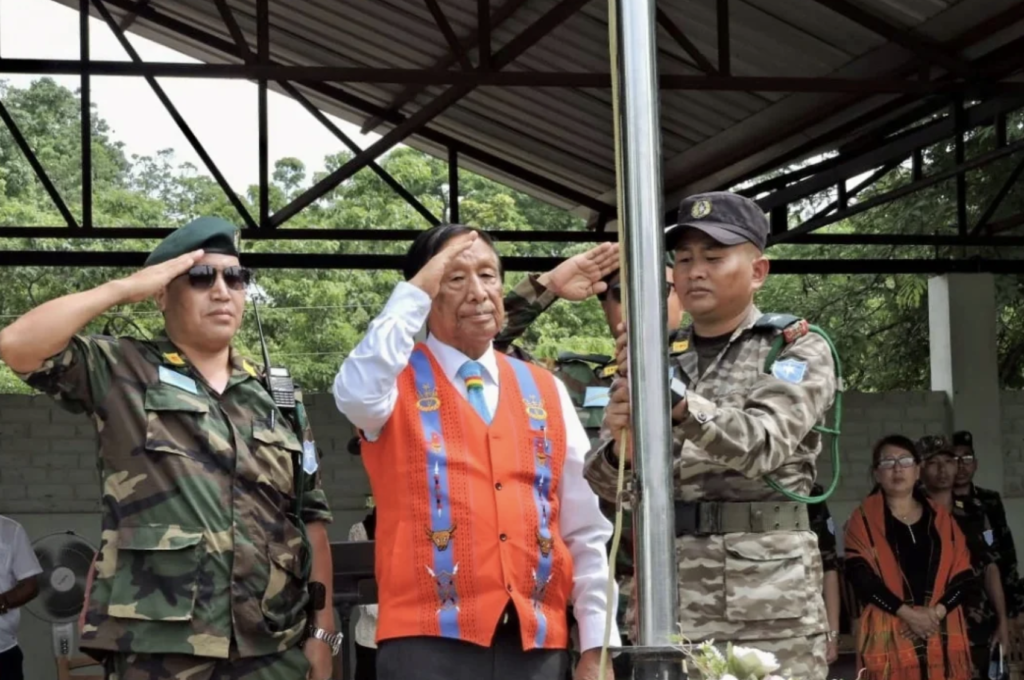
(NSCN-IM’s General Secretary Thuingaleng Muivah on 14 August 2026, Image Source: Nagaland Tribune)
Much of the reason for the government’s conviction that it has won is influenced by the absence of militancy-related fatalities. The Centre and NSCN-IM entered into a ceasefire in 1997, beginning negotiations for a political resolution to the long-standing conflict. In 2015, they signed a Framework Agreement, heralding hopes of a negotiated end to a conflict which has spanned several decades.
Since 2016, Nagaland hasn’t witnessed double-digit fatalities in any year. Total fatalities in the last ten years have been 34, of whom 19 were insurgents. Between 2020 and 2025, not a single security force individual was killed in the state. These are impressive figures for a state that houses the longest-running insurgent faction in the entire country. The NSCN-IM, which maintains a headquarters—Camp Hebron—in Dimapur, has more than 2,500 armed cadres. Most of them are in the headquarters and other designated camps. But some of them are outside, in Nagaland and the neighbouring states of Manipur and Arunachal Pradesh.
A few hundred cadres, calling themselves the Eastern Flank, are based in neighbouring Myanmar’s Sagaing division, although the border. NSCN-IM never approved of the group and termed its activities as “anti-national.” On 24 June this year, it expelled two senior cadres, Ramsan and Absalom Raman, followed by another expulsion, that of Ikato Chishi Swu on 7 July. Swu is the son of late NSCN-IM co-founder, Isak Chishi Swu. On occasion, cadres of the Eastern Flank and the NSCN-IM have clashed in Manipur and also in Myanmar, resulting in fatalities.
The conflict economy and ‘negative peace’
While the India-based cadres do not indulge in any violence against the security forces, they do collect ‘taxes’ from businesses, transporters, and ordinary civilians. This money, interpreted by the organisation as a matter of its legitimate right, has been vital to support its offices, pay its cadres, and maintain the paraphernalia of armed militancy. While no current estimates exist, the group presented a total budget of Rupees 170 crore in 2016, approximately $25 million at the then-prevailing rate. New Delhi expressed its concerns on this matter from time to time but took few steps to deal with the matter. Analysing the conflict economy of the Naga insurgency was the subject of an earlier MISS assessment, which identified the undisrupted flow of money into the coffers of the group as the prime reason for its survival.
For New Delhi, allowing the NSCN-IM to run a mini parallel government of sorts in Nagaland and beyond was acceptable as long as the group refrained from overt violence. At the same time, it was determined to maintain the framework agreement signed in 2015 with the group while simultaneously rejecting the repeated demands of a separate flag and/or constitution. The thought appears to have been that settling into normalcy would dissuade the militants from returning to violence. The highly fractured insurgency was assessed to pose no threat to India’s national security, rather judged a tolerable localised nuisance in a remote corner of the country. The last formal meeting between the government and the NSCN-IM was held in October 2024.
The NSCN-IM too appeared to have played along. In exchange for the autonomy it received from the government, the group periodically protested and expressed dissatisfaction over the government’s refusal to honour the 2015 Framework Agreement and recognise the unique nature of the Naga movement. It released the text of the Agreement in 2020 in a bid to build pressure, and it issued veiled threats, stating that its patience was not infinite. Nonetheless, the idea of renewing hostilities against the Indian nation was never perceived in New Delhi as a viable option. In fact, the group never crossed the red line which would have led the government to target it with large-scale military operations. The error by the NSCN-IM leadership, though, was to overlook growing discontentment among a tranche of its cadres.
Opaque peace process and internal splintering
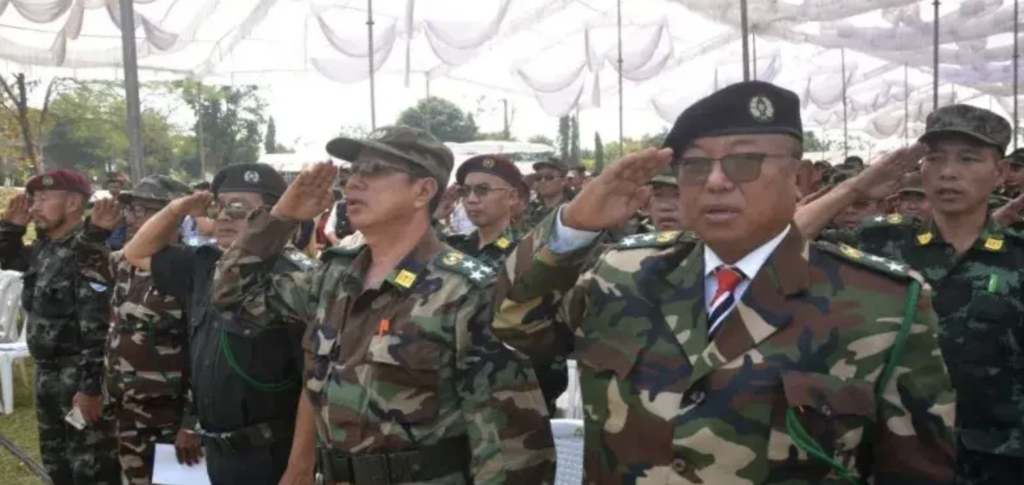
(Formation of the Provisional Government by the Eastern Flank, Image Source: NE Wire In)
Indefinite and opaque peace processes can manufacture the very factionalism they’re meant to prevent. On 21 July, the NSCN-IM split. A group of leaders belonging to the Eastern Flank faction held an “extraordinary joint emergency meeting” at Mt Horeb Camp in Myanmar’s Sagaing region, and announced the formation of a nine-member “provisional government.” They claimed that the spirit of the ceasefire agreement with the Centre had “ceased to exist.” They rationalised their move as a step to save “the nation from another surrender” and called for “rescuing the Naga political movement from its present predicament.”
The Eastern Flank is headed by the two expelled leaders of the NSCN-IM—Ikato Chishi Swu as chairman and Hs Ramsan as vice chairman. Swu had joined the Myanmar-based faction in April 2025, saying he had lost confidence in the present leadership of the NSCN-IM. The group has rejected the Framework Agreement and accused the leadership of engaging in “meaningless and endless” talks and failing to act after the Centre’s “betrayal” of the Agreement.
The immediate impact of the split isn’t known, but it could have twin consequences. First, it could potentially deepen the existential crisis for the NSCN-IM, especially in terms of providing a platform for cadres staring at a blank future—disenchanted with the stalemate the insurgency faces and the possibilities of disintegration after Muivah.
Second, the Eastern Flank’s formal establishment, with its rejection of its parent group’s submission to New Delhi, could constitute a headache for India. The new group has asserted that the spirit of the 1997 ceasefire agreement has ended and that it will continue both political and armed resistance to safeguard the “sovereign existence” of the Naga nation.
At one level, this is an expression of negotiation. At the other, it is a declaration of war. It isn’t clear, given the fact that the government hasn’t thus far reacted to the development, which of these two will lead. While the first option is an irritating process, the second could meet with limited progress and produce a legitimate candidate for aid and assistance by China. Beijing already has a strong presence in Myanmar and is suspected by New Delhi of seeking to restart insurgencies in the northeastern region.
Counternarratives and contested legitimacy: The Rise of the Eastern Flank
The NSCN-IM leadership, which can contest the split narrative by claiming that the Eastern Flank was never a legitimate movement component to begin with, is nevertheless feeling the heat and has pushed NSCN-IM to harden its position vis-à-vis New Delhi. The Eastern Flank’s criticism of its approach to the “Naga struggle for self-determination” thus has led to two statements by NSCN-IM leadership.
On 3 August, marking the 10th anniversary of the signing of the Framework Agreement, NSCN-IM Chairman Q Tuccu reaffirmed that the 2015 accord with New Delhi remains the only basis for resolving the Naga political issue, even while accusing New Delhi of “delaying” the final settlement.
This was followed by a similar statement by Muivah on 14 August 2026, the day the group celebrated its Independence Day. Muivah reiterated that the matter of the Naga national flag and constitution will not be compromised, while accusing the government of India of violating the “letter and spirit” of the 3 August 2015 Framework Agreement. He maintained that the Naga national flag, constitution, sovereignty, and sovereign territory were among the “non-negotiable national issues” mandated by the Naga people.
While this was an exercise to keep his flock together, it will be ineffective without concrete steps to foster a sense of optimism among the members. Clearly, the group’s leadership lacks the capacity to achieve this without some form of accommodation from New Delhi regarding its demands. At 91, Muivah’s options are limited, and he is unlikely to consider a renewed armed struggle. Ultimately, a drifting situation will only strengthen the ranks of the Eastern Flank. New Delhi needs to consider this possibility.
Beyond the Gamble
New Delhi’s Naga policy has rested on a wager that time, comfort, and Muivah’s mortality would together resolve Naga insurgency. That wager is now looking a bit shakier than it has in a decade.
A ceasefire without an end goal was always likely to produce exactly what it has—a rival claimant with a bloodline to the movement’s founding generation, a base of disillusioned cadres, and a sanctuary next door where the state has no writ. The Eastern Flank’s provisional government is not a bolt from the blue. It is the predictable consequence of a peace process that has been managed rather than used to work for resolution of long-standing grievances and alienation.
The choice facing New Delhi is thus no longer to pick between status quo or negotiation. Treating the Eastern Flank purely as a security problem risks handing Beijing a foothold it has long sought in the Northeast, through a group with cross-border shelter in a fractured Myanmar. Conversely, treating the negotiation as the fallback position risks legitimising fragmentation as a strategy and inviting further splits from every faction that senses Delhi will eventually deal with whoever holds a gun and a name. The only durable path could be a transparent and time-bound settlement with NSCN-IM that gives Muivah’s ageing leadership something to show its cadres before the question of succession is decided by a funeral rather than a framework of settlement.
(Dr. Bibhu Prasad Routray is the Director of MISS. This analysis has been published as part of Mantraya’s ongoing “Mapping Terror & Insurgent Networks” and “Fragility, Conflict, and Peace Building” projects. All MISS publications are peer-reviewed.)