
MANTRAYA ANALYSIS #103: 04 AUGUST 2026
SHANTHIE MARIET D’SOUZA & BIBHU PRASAD ROUTRAY
Abstract
Even as Washington and Beijing cycle through high-level summits seeking strategic stability, aggressive vying for dominance on the ground in Southeast Asia has not ceased. US strategy has hitherto focused in the Asia-Pacific generally on building an integrated network of regional alliances. Beijing, on the other hand, has responded with a highly calculated, multi-pronged counter-strategy designed to fracture Washington’s influence and pull Southeast Asia closer into its orbit. In response, Southeast Asian countries are diversifying toward middle powers such as Japan, India, and BRICS members rather than aligning fully with either Washington or Beijing.
Contending Sovereignty: Chinese belligerence & Philippines’ claims
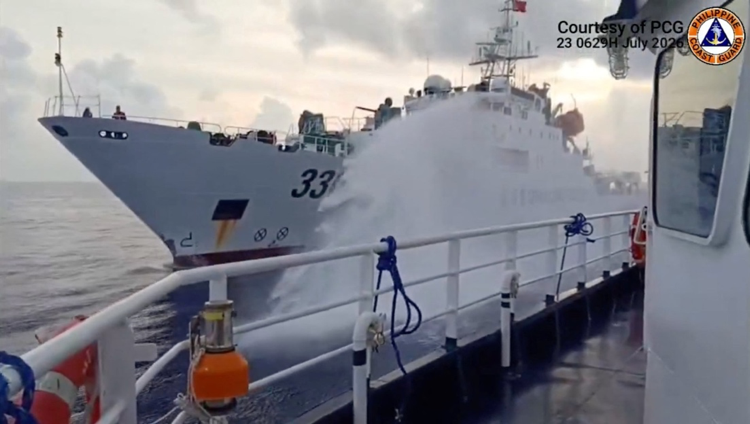
During 23-24 July, on two occasions, Chinese Coast Guard vessels fired water cannon at Philippine fisheries boats at the Scarborough Shoal in the South China Sea. The Philippine Coast Guard said that a Chinese vessel came within about 7 metres of a Philippine fishing boat, creating “a serious risk of collision”. The Chinese Coast Guard, on the other hand, defended their action as “control measures” on Philippine vessels that “were operating illegally in waters around Scarborough Shoal.” The Philippines claims the Shoal as falling within its exclusive economic zone (EEZ). However, China has long occupied the shoal by using an armada of coast guard ships deployed throughout the South China Sea. Beijing claims sovereignty over almost the entire South China Sea, including parts of the EEZs of Brunei, Indonesia, Malaysia, the Philippines, and Vietnam.[1]
On 20 July, at the Second Thomas Shoal, 650 kilometres away from Scarborough Shoal, a Filipino sailor was injured after being struck with a baton by Chinese Coast Guard personnel. China accused the Philippine navy of ignoring warnings and of trying to ram into a Chinese patrol boat, and the countries summoned each other’s ambassadors in protest.
Coincidentally, these incidents took place as Southeast Asian foreign ministers concluded their 59th ASEAN Foreign Ministers’ Meeting, held in Manila between 18 and 23 July. Chinese Foreign Minister Wang Yi and US Secretary of State Marco Rubio attended the meetings. Rubio called Beijing’s actions in the South China Sea “disturbing,” and he reaffirmed support for defence treaty ally the Philippines. Wang Yi, on the other hand, displayed an unapologetic attitude, saying, it is up to the Philippines “to make the correct, rational decisions about the path their relations will take.”[2]
No Consensus: US –China rivalry
The ASEAN Foreign Ministers’ Meeting and related events in Manila were held under the theme “Navigating Our Future, Together” and focused on the South China Sea code of conduct, regional security, and global crises. Traditionally, ASEAN countries have kept their trade and investment relations with China intact while relying on US security guarantees. However, that strategy has come under strain with the intensification of US-China rivalry and the uneven US strategic posture.[3] As a result, instead of clearly picking a side and seeking to become a member of one group, most countries are seeking to diversify toward middle powers such as Japan, India, Australia, the EU, and regional groupings such as BRICS.
The US Department of State used the terms “dangerous and provocative”[4] to describe the recent Chinese actions vis-à-vis the Philippines. Rubio, in Manila, was categorical in affirming that the US has “a role” and is “not going to” abandon its allies. The Philippines, which is clearly banking on such assurances, has recalibrated and deepened the alliance with the US by providing the American troops access to nine Enhanced Defence Cooperation Agreement sites, expanding the Balikatan exercises (the 2026 chapter concluded in May) and joining a trilateral operation with the US and Japan that positions the Philippines as a frontline partner in the Luzon Strait.
US strategic drift aside, the Iran war and the resultant energy crisis have made the country revisit some of its policies. Manila, for instance, has imported 700,000 barrels of crude oil directly from Russia, bypassing Western sanctions. President Marcos has also signalled openness to joint oil and gas exploration with China in the South China Sea. Nevertheless, Manila’s current posture toward China is much firmer than it was under the International Criminal Court (ICC)-indicted Rodrigo Duterte, the previous president, although it does try to avoid being seen as overly dependent on the US.
Conscious Non-Alignment: Malaysia and Indonesia
The approaches of countries such as Malaysia, Indonesia, Vietnam, and Thailand are somewhat similar.
Malaysia pursues a policy of conscious non-alignment.[5] Prime Minister Anwar Ibrahim has insisted that his country will not bow to external pressure from global powers such as the United States or China. At one level, Malaysia’s economic dependence on China has deepened, particularly in energy and infrastructure. In 2024, Sino-Malay bilateral trade reached a record $212 billion; and for the sixteenth consecutive year, China remained Malaysia’s largest trading partner. This deliberate economic entanglement demonstrates Malaysia’s desire to maximise economic gain from China. At the same time, Malaysia is diversifying its security and economic partnerships beyond the US and China. For instance, PM Ibrahim, during his 10 June 2026 visit to Tokyo, committed to strengthening cooperation with Japan on energy security, maritime security, and critical minerals.[6] In 2024, Malaysia was also made a BRICS partner country. That move signals hedging toward alternative groupings rather than picking a side between the US and China.
Indonesia too has opted for a policy of strategic autonomy. President Prabowo Subianto has tried to fend off pressure from both the US and China. It has not agreed to Washington’s pressure to grant US aircraft blanket access to its airspace and to allow its infrastructure to host maintenance and repair operations for US naval and air force assets.[7] Similarly, it is non-committal to China’s proposal for the joint development in the North Natuna Sea by asserting that it does not recognise China’s nine-dash line and any future cooperation must comply with Indonesian law and UNCLOS.[8]
In October 2024, shortly after Subianto became President, Jakarta claimed it had, on two occasions, chased away Chinese Coast Guard vessels impeding a seismic survey being conducted by a state-owned company in the North Natuna Sea. In June 2026, Jakarta restarted the long-delayed offshore Tuna gas project in the Natuna Sea after securing a renewed commitment from Russia’s state-controlled energy company Zarubezhneft to continue developing the project.[9] At the same time, Indonesia has sought to broaden its strategic alignment by becoming the first ASEAN state admitted as a full BRICS member in 2025. It is also accelerating diversification of its energy-diplomacy partnerships rather than depending on any single nation.
Middle Ground Policy: Vietnam and Thailand
Vietnam is seeking to manage the US-China rivalry by committing itself to its traditional policy of not establishing formal alliances with either of them and providing any bases to any foreign country.[10] As a result, it has managed to absorb pressure from Beijing over the South China Sea while deepening ties with Washington in areas of defence and technology. Since the US removed an embargo on arms sales to Vietnam in 2016, both nations have built close security and strategic cooperation that culminated in a Comprehensive Strategic Partnership in 2023. At the same time, Hanoi’s economic ties with China have expanded and reached $290 billion in 2025, driven by manufacturing supply chains, cross-border railway projects, and rising import-export volumes. China is Vietnam’s largest trading partner. Since Vietnam is in the proximity of Hainan Island and China’s Longpo naval base that hosts part of Beijing’s nuclear submarine fleet, Beijing cannot afford to alienate Vietnam. Vietnam is also a BRICS partner-country since 2024, which indicates its diversification goals.
America’s oldest treaty ally in Asia, Thailand, is following a classic middle ground policy. Its Royal Thai Armed Forces host Cobra Gold joint exercises with the US Pacific Command (the latest instance took place in March 2026), while also buying an S26T diesel-electric submarine and conducting the ‘Falcon Strike’ joint air force training with China. It leans heavily on China to boost its sluggish economy. Beijing is its top trading partner and a primary source of infrastructure investment, such as high-speed rail. In September 2025, Thai prime minister Anutin Charnvirakul declared that his country will deepen cooperation with China, including in areas such as semiconductors and battery production. There is a realisation in Thailand that its location gives it independent strategic weight. It serves as a priority for China seeking to have secure access to the Strait of Malacca. That allows Thailand to retain a flexible foreign policy position which avoids granting either the US or China exclusive military access or becoming their proxy. Economically, Thailand has also joined the BRICS partner track alongside Malaysia and Vietnam.
Prognosis: Pragmatic Diversification or Binary Alignment?
Across Southeast Asia, the trajectory points to pragmatic diversification, rather than binary alignment. In the years ahead, that is likely to define the region’s response to intensifying US-China contestation. Amid Washington’s apparent deepening of its network of alliances and Beijing’s assertive maritime posture, ASEAN states are likely to further institutionalise their hedging strategies by expanding partnerships with middle powers such as Japan, India, Australia, South Korea, and the EU, while simultaneously formalising ties with BRICS and other non-Western groupings. The underlying objective is to preserve strategic space and avoid becoming a proxy battleground.[11]
While this may appear pragmatic and the correct way forward for ASEAN as a bloc, challenges will be posed in translating individual member states’ hedging behaviour into a more coherent collective position. Unilateral incidents such as those at Scarborough Shoal and Second Thomas Shoal – which are not unusual, lack of regular coverage notwithstanding – will likely recur and continue to test the limits of ASEAN centrality, even with the unlikely conclusion of the South China Sea Code of Conduct negotiations between the organisation and China. Therefore, a strategy that combines detachment, strategic autonomy, and hedging may prove to be insufficient to preserve the region’s strategic independence. It is quite likely that Southeast Asia’s pragmatic multilateralism will mostly hinge on the region’s capacity to extract economic and security benefits not only from both great powers but also from their alternatives.
[1] For detailed coverage, Wan Kurniawan, “Dragon’s Gambit: China’s Gray Zone Strategy in the South China Sea,” Journal of Counterterrorism & Homeland Security International 29.3 (2025), 38-47. Sovereignty over the Scarborough Shoal, which China calls Huangyan Island, has not been established. A 2016 arbitration decision on a case lodged by the Philippines ruled largely in favour of Manila and said China’s blockade of the shoal violated international law. Beijing does not recognise the ruling. Its posture in the South China Sea may be compared to that of Russia in Crimea, with the Chinese Coast Guard used in lieu of Moscow’s “Little Green Men.”
[2] “ASEAN Foreign Ministers’ Meeting: Chinese FM Wang Yi conducts bilateral meetings on sidelines of ASEAN foreign ministers’ gathering”, CGTN, 24 July 2026, https://news.cgtn.com/news/2026-07-24/VHJhbnNjcmlwdDkxNjcy/index.html.
[3] Crucially, Cambodia, as a long-time Chinese asset embedded in an organisation requiring unanimity for action, prevents all meaningful ASEAN response to Chinese expropriation of the South China Sea. Though dated, a useful assessment is Gordon Houlden, Scott N. Romaniuk, Nong Hoing, eds. Security, Strategy, and Military Dynamics in the South China Sea: Cross-National Perspectives (Bristol, UK: Bristol University Press, 2021), see esp. Ch.10, Veasna Var, “Cambodia’s South China Sea Policy: From ASEAN Aligned to Echoing Chinese Clientism.” The chapter title makes the point, albeit the content is scholarly rather than polemical.
[4] U.S. Department of State, “China’s Actions Against Philippine Navy Personnel at Second Thomas Shoal”, 20 July 2026, https://www.state.gov/releases/office-of-the-spokesperson/2026/07/chinas-actions-against-philippine-navy-personnel-at-second-thomas-shoal
[5] Fazleena Aziz, “PM: M’sia will remain a non-aligned nation”, The Star, 3 July 2026, https://www.thestar.com.my/news/nation/2026/07/03/pm-msia-will-remain-a-non-aligned-nation
[6] Ministry of Foreign Affairs, Malaysia, “Japan-Malaysia Joint Statement”, Tokyo, 10 June 2026, https://www.kln.gov.my/web/guest/-/japan-malaysia-joint-statement-june-10-2026-tokyo.
[7] “Indonesia signed letter but made no commitment to US on airspace access, defence minister says”, Reuters, 19 May 2026, https://www.reuters.com/world/asia-pacific/indonesia-made-no-commitment-us-airspace-access-defence-minister-says-2026-05-19/.
[8] “Indonesia still does not recognise Beijing’s South China Sea claims: minister,” South China Morning Post, 2 December 2024, https://www.scmp.com/news/asia/southeast-asia/article/3289017/indonesia-yet-agree-beijing-joint-development-areas-south-china-sea-minister.
[9] “Natuna gas project revival tests Indonesia’s balancing act between China and Russia”, The Print, 27 July 2026, https://theprint.in/diplomacy/natuna-gas-project-revival-tests-indonesias-balancing-act-between-china-and-russia/2997785/.
[10] This is commonly referred to as the ‘Three Nos’ (later expanded to “Four Nos’) defense policy that prohibits (i) military alliances, (ii) foreign military bases, (iii) siding with one country against another, and (iv) using force.
[11] Useful (analysis included Southeast Asia) is Navigating Disruption: Ally and Partner Response to U.S. Foreign Policy (Washington, DC: CSIS, October 2025), https://features.csis.org/responses-to-US-foreign-policy/.
(Dr. Shanthie Mariet D’Souza is the Founder & Executive Director of MISS. Dr. Bibhu Prasad Routray is the Director of MISS. This analysis has been published as part of Mantraya’s ongoing “Fragility, Conflict, and Peace Building” projects. All MISS publications are peer-reviewed.)