MANTRAYA SPECIAL REPORT#29: 25 NOVEMBER 2026
AASHISH GANESHAN, BIBHU PRASAD ROUTRAY, & SHANTHIE MARIET D’SOUZA
Abstract
The Hafiz Gul Bahadur Group (HGBG) has emerged as one of the most potent militant organisations in the Pashtun borderlands of Pakistan and Afghanistan. It derives its name from leader Hafiz Gul Bahadur, a former cleric. For nearly two decades, the group has acted as a tribal-Islamist hybrid. From its initial reluctance to fight Islamabad, the group is now challenging the Pakistani state. This makes the group an interesting case study to understand the changing nature of insurgency in the region.
From Tribal Host to an Insurgent Actor: The Good and the Bad Taliban
Gul Bahadur belongs to the Mada Khel clan of the Utmanzai Wazir tribe in North Waziristan, along the Pakistan-Afghanistan border. Little is publicly known about his early life, although local accounts link him to the student wing of Jamiat Ulema-i-Islam (Fazl). He reportedly fought alongside the Afghan Taliban against the Northern Alliance before the US-led intervention in 2001. After the Taliban’s fall, he became an influential figure in North Waziristan, sheltering Afghan Taliban members and other foreign insurgents who had crossed into Pakistan. His influence rested on tribal connections, militant alliances, and his ability to negotiate with Pakistani authorities.
Unlike several other Pakistani Taliban commanders, Gul Bahadur initially prioritised fighting the insurgency in Afghanistan over confrontation with Islamabad. He was named first deputy of the Pakistani Taliban (Tehreek e Taliban Pakistan, TTP) when it formed in December 2007, but infighting plagued the movement because he insisted on targeting the internationally backed Afghan regime rather than the Pakistani government. He signed a peace agreement with Islamabad on 18 February 2008. The pact was designed to restore the troubled September 2006 agreement between the Pakistani government and the tribal leaders of North Waziristan. Unlike the earlier deal—which focused largely on the Miramshah area—this agreement was intended to encompass the entire North Waziristan Agency.
This posture defined the group for years. It sheltered Afghan Taliban and Haqqani Network fighters and ran a parallel administration in North Waziristan while largely refraining from attacks inside Pakistan. For several years, Islamabad and the Inter Services Intelligence (ISI) treated Hafiz Gul Bahadur as part of the ‘good Taliban’, which refrained from attacking Pakistani forces and focused on fighting U.S. and NATO troops in Afghanistan.
However, a break from this approach came after the 2014 Zarb-e-Azb offensive by the Pakistan military in response to the attack on Jinnah International Airport in Karachi on 8 June that year. The HGBG leadership relocated across the border. Its relationship with the Afghan Taliban stayed intact, but changed completely with Islamabad. Gul Bahadur formally ended his truce with the Pakistani state and declared war on it.
Alliance, Not Subordination: The Symbiotic Relationship with the TTP
HGBG is often described as a TTP affiliate, but the relationship has always been one of alliance rather than subordination. The group has guarded its autonomy, with its own command, media output, and local priorities. It has also had factional sub-units, including the Jaish-e-Omeri wing. The distinction is important notwithstanding the claims of the Pakistani officials frequently grouping all insurgents together, even as HGBG claims to have a distinct chain of command.
HGBG follows the Deobandi tradition, draws heavily on its Pashtun tribal base, and maintains a historical allegiance to the Afghan Taliban’s leadership. Its early strategy prioritised jihad against foreign forces in Afghanistan rather than confrontation with Pakistan, with which Gul Bahadur maintained irregular peace arrangements. That position underwent a complete change as military operations, drone strikes, and the post-2021 political climate pushed the group toward confrontation with Islamabad. Analysts describe its newer coalition as anti-Western, jihadist, and nationalist. Its stated grievances now combine opposition to the Pakistani military, defence of tribal territory, and demands for sharia-based governance.
Ittihad-ul-Mujahideen Pakistan: Organisational Shift and Strategic Communications
A major organisational shift came on 11 April 2025, when the media wings of HGBG, Lashkar-e-Islam, and Harakat-e-Inqilab-e-Islami jointly announced the formation of a unified Ittihad-ul-Mujahideen Pakistan (IMP). Gul Bahadur was widely seen as the architect, although the alliance never formally named a leader. IMP gives HGBG a banner distinct from the TTP, with a shared brand across North Waziristan and Tirah.
Media output has become an important part of HGBG’s identity, particularly in distinguishing itself from the TTP. The group uses statements, attack claims and digital propaganda to communicate its activities and maintain visibility. IMP provides a common platform through which its constituent groups can publicise operations while retaining their individual identities. This also complicates attribution, as attacks may be claimed under the alliance’s name rather than that of an individual faction.
Escalation against the Pakistani state: The strengthening nexus with Afghan Taliban and the Haqqani Network
After the Afghan Taliban took control of Afghanistan in August 2021, the HGBG, with a safe rear base in eastern Afghanistan (such as Khost and Paktika) and deep ties to the Haqqani Network, redirected its fighters and suicide bombers squarely against Pakistani security forces. Among the Taliban’s many constituents, HGBG’s ties with the Haqqani Network remain the strongest.
HGBG’s record in the past several years shows steady escalation. In July 2024, ten militants attacked Bannu Cantonment, killing eight security personnel before all ten attackers were killed. The ISPR attributed the attack to HGBG, alleging that it operated from Afghanistan. In March 2025, the group struck Bannu again, during Ramadan, killing five soldiers and 13 civilians, with several casualties resulting from the collapse of nearby buildings.
The most lethal attack came on 28 June 2025 at Mir Ali, where an explosive-laden vehicle rammed into a military convoy in a suicide attack, killing at least 13. HGBG claimed responsibility. This attack triggered a diplomatic dispute. Pakistan’s military alleged that India had sponsored the bombing and described the attackers as Indian-backed militants. India’s Ministry of External Affairs rejected the accusation. The sharply different accounts of casualties and external blame illustrate the heavily politicised information ecosystem surrounding such attacks.
Changing Tactics and Innovation: Traditional blends with Modernity
HGBG blends legacy insurgent methods with modern ones. Its core toolkit is comprised of the suicide bomber, the vehicle-borne IED, and the complex assault on police and military compounds, as at Kohat and Bannu. Its pattern increasingly concentrates on police stations, military compounds, checkpoints, and security patrols, particularly across North Waziristan and Bannu.
The group’s most distinctive innovation is the use of drones. Between July and September 2024, security forces suffered six unclaimed UAV attacks in North Waziristan, an HGBG stronghold. All appear to have used Chinese commercial DJI drones. These early incidents cannot be conclusively attributed to HGBG, but IMP began publicly claiming drone operations in mid-2025, making drones part of the alliance’s operational identity. Analysts note that IMP was the first to use drones over North Waziristan and Bannu, though it has not announced a dedicated drone unit. By contrast, the TTP publicly announced its drone wing in December 2025.
Drones are used for reconnaissance and for dropping small explosive payloads, often coordinated with ground ambushes. They are cheap, hard to attribute, and compel defenders to use costly countermeasures, such as jamming (costly when considered long-term and factoring in collateral effects). They have also caused collateral damage, including people on the state’s side. In Bannu, police recorded 20 militant drone attacks during 2025, resulting in nine civilian deaths and injuries to 19 police personnel.
Drones let militants conduct reconnaissance and threaten fortified positions without relying solely on ground assaults, and they impose extra security costs by forcing police and military units to acquire and service specialised equipment. Their destructive capability thus far, however, remains relatively limited. After an anti-drone system was installed in Bannu on 18 July 2025, Bannu police reported thwarting more than 300 attempted drone attacks and neutralising four drones. The pattern suggests an emerging tactical trend rather than a decisive technological breakthrough, though it must be noted that other insurgents, such as those in Colombia, have quickly learned to up the ante. In Pakistan, civilian casualties and the difficulty of establishing responsibility for unclaimed strikes further complicate the security landscape.
Rising Attacks and Pakistani Counter-terrorism Response
The first eleven months of 2026 witnessed continued insurgent activity across North Waziristan, Bannu, and other districts of Khyber Pakhtunkhwa, alongside an intensified Pakistani counterterrorism campaign. Responsibility was frequently attributed to unidentified militants or other TTP factions, so not every incident below can be treated as an HGBG or IMP operation.
In January, unidentified militants used quadcopters to attack Al-Fatah Public School in Khasokhel, Mir Ali, injuring three people, including the principal and a Rescue 1122 worker. A second drone reportedly dropped a mortar shell near the rescue operation. On 22 February, militants dropped explosives on the Gumbati police post without causing casualties, and on 27 February a quadcopter attack on a mosque in Miryan injured five people. On 21 June, another drone attack injured a Frontier Corps soldier near Syedgi. These incidents show both the geographical spread of drone violence and its reach beyond military targets, though none was independently attributed to HGBG or IMP.
A more direct link emerged on 6 March, when the affiliated Aswad-ul-Khurasan claimed a suicide bombing near Chashma Pul Check Post on the Bannu–Miranshah road, which killed one person and injured 19, including two security personnel. Pakistani security sources also tied a Bannu suicide attack on an army vehicle to the group, with IMP claiming responsibility, and cited it as evidence that Afghan soil serves as a staging ground.
By February 2026, HGBG and other Pakistan-focused networks had become targets of Pakistani strikes across the Afghan border. On 21–22 February, Pakistan conducted airstrikes against suspected militant positions in Afghanistan (reported in Nangarhar, Khost and Paktika) following a series of attacks inside Pakistan. Pakistani security sources claimed the strikes killed Akhtar Muhammad, reportedly a deputy in Gul Bahadur’s network, and an al-Qaeda operational commander. Deputy Interior Minister Talal Chaudhry and Information Minister Attaullah Tarar defended the operation as targeting groups responsible for recent attacks. Afghan authorities disputed Pakistan’s account, alleging that civilian areas had been struck. The reported casualties and identities remain independently unverified.
On 26 July, IMP claimed an IED attack on a security patrol in Nari Keli, North Waziristan, killing two soldiers and injuring another. On 2 August, security forces killed eight HGBG militants while thwarting an infiltration near Datta Khel.
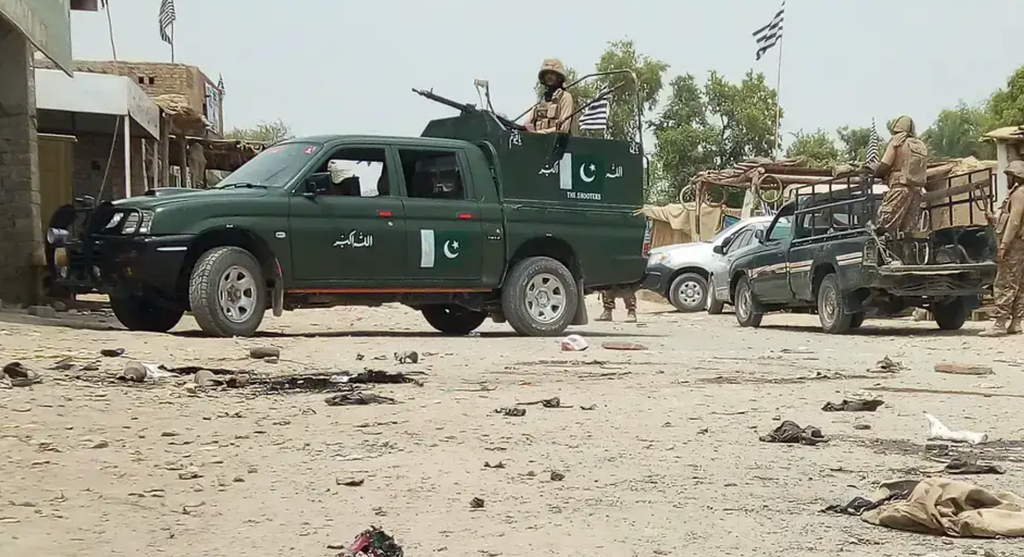
The most significant escalation came on 18 September, when a VBIED detonated inside the Kohat Police Lines compound, followed by an armed assault on police and security installations. The siege lasted roughly 22 hours before all attackers, including suicide bombers and a sniper, were killed. The attack killed 17 police personnel and six civilians. IMP, described as an alliance of TTP offshoots led by Gul Bahadur, claimed responsibility after the Pakistani president initially blamed the TTP, which denied involvement.
On 16 October, the Counter-Terrorism Department said it had killed the alleged mastermind, Zahid Gul, a Hafiz Gul Bahadur group member, in Lakki Marwat’s Walai Sagai area. Officials said he helped transport suicide bombers and was tied to a bank robbery whose proceeds went to militants in Bannu, which points to a financing model that combines local criminal proceeds with tribal and external sources. On 2 November, security forces reportedly killed two highly wanted Gul Bahadur Group militants in an intelligence-based operation in Sardi Khel Mandi, North Waziristan. Despite leadership losses and sustained military pressure, HGBG-linked networks and their IMP platform remained active.
Prognosis
HGBG’s trajectory shows a pragmatic movement shifting from a tolerated tribal host to an active insurgency. The crucial factors that sustain the group’s violent action include its haven in Afghanistan, its alliance structure through IMP that lets it scale up without being dependent on the TTP, and its technological adaptation, especially the use of drones, which shows how quickly low-cost commercial technology can erode conventional security advantages. The killing of mid-level commanders has not stopped the tempo, as an 83 per cent rise in violence-related fatalities nationwide in the third quarter of 2026 proves. The group is thus emerging as a lethal force to reckon with in the region.
(Aashish Ganeshan is a Research Associate at MISS. Dr. Bibhu Prasad Routray is the Director of MISS. Dr. Shanthie Mariet D’Souza is the Founder & Executive Director of MISS. This Special Report is part of Mantraya’s ongoing ‘Fragility, Conflict, and Peace Building’ and ‘Mapping Terror & Insurgent Networks‘ projects. All MISS publications are peer-reviewed.)